The AIM Era: Away Messages, Buddy Lists & the Birth of Online Identity

AIM promotional graphic from aim.com (archived 2002)

AIM beta banner (archived 2005)
It's 3:47 PM on a Tuesday in 2003. You just got home from school, dropped your backpack by the door, and made a beeline for the family computer in the den. You jiggle the mouse to wake the CRT monitor, double-click the little yellow Running Man icon, and wait. The buddy list populates. Names appear one by one - some grayed out, some bold and alive. The door-opening sound plays: creak. Your best friend just signed on. You type "hey" before they even finish loading. This was the ritual. This was AIM.
AOL Instant Messenger wasn't just software. It was the social operating system for an entire generation of American teenagers. It was where you flirted, fought, broke up, made up, planned Friday nights, shared secrets, and crafted the perfect away message that said everything without saying anything at all. For roughly a decade - from the late 1990s to the late 2000s - AIM was the center of teenage social life in the United States.
This is its story.
The Birth of AIM - May 1997
AIM's origin story is one of those beautiful accidents of early internet history. In May 1997, three AOL engineers - Barry Appelman, Eric Bosco, and Jerry Harris - uploaded a small instant messaging client to an AOL FTP server. There was no marketing campaign, no press release, no launch event. They just... put it out there.
900 users downloaded it overnight.
That number might sound modest by today's standards, but in 1997, on an unadvertised FTP upload, it was a lightning bolt. AOL management took notice. Here was a product that people wanted - desperately, immediately, without being told to want it. The concept was simple: take the instant messaging feature that AOL subscribers already used inside the AOL walled garden, and make it available to anyone on the internet for free.
The decision to make AIM free and open to non-AOL users was radical. AOL was a subscription service - people paid $21.95/month for access. Giving away one of its best features for free seemed insane. But it was a stroke of genius. AIM became AOL's Trojan horse on the open internet, keeping the AOL brand relevant even as the walled-garden model crumbled.
Peak AIM: 1999-2006
By the early 2000s, AIM wasn't just popular - it was dominant. At its peak, AIM commanded a staggering 52% of the instant messaging market in the United States. On any given day, 36 million users were signed in simultaneously. In American high schools and college dorms, AIM penetration was essentially 100%.
The numbers only tell part of the story. AIM wasn't just a messaging app - it was the after-school ritual. The pattern was universal across millions of American households:
- Get home from school (3:00-3:30 PM)
- Grab a snack
- Sign on to AIM
- Check who's online
- Start conversations with 4-8 people simultaneously
- Update your away message when dinner's called
- Sign back on after dinner
- Stay on until parents yell to get off the computer (or the phone line)
This was before smartphones, before social media feeds, before Netflix. AIM was the entertainment. The buddy list was your social feed. The conversations were your content. And the away messages were your status updates - years before Facebook or Twitter existed.

AIM color customization - because your personality needed a font (archived 2007)
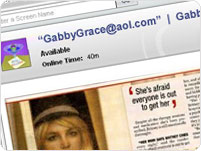
AIM profiles - your first social media bio (archived 2007)
AIM's dominance in the US was so complete that it shaped business communication too. Office workers used AIM to chat with colleagues. Journalists used it to coordinate with sources. The OSCAR protocol (Open System for CommunicAtion in Realtime) that powered AIM became one of the most reverse-engineered protocols in internet history.
Away Messages: The Original Status Update
If AIM had one feature that defined a generation, it was the away message. On paper, it was simple: a short text that displayed when you were away from your computer. In practice, it became the most important form of self-expression on the early internet - proto-social media in its purest form.
Away messages were never really about telling people you were away. They were about performing. They were carefully crafted broadcasts to your entire buddy list - a one-to-many communication channel disguised as a status indicator. And the art form had rules.
The Away Message Taxonomy
- The Song Lyric: By far the most common. Dashboard Confessional, Taking Back Sunday, Brand New, Something Corporate - if it was emo, it was in someone's away message.
"Your lipstick, his collar, don't bother angel, I know exactly what goes on"wasn't just a lyric. It was a statement. And everyone on your buddy list knew exactly who it was about. - The Passive-Aggressive Poetry:
"some people just aren't worth the effort anymore..."- vague enough to deny, specific enough that the target knew. This was subtweeting before Twitter existed. - The Schedule Flex:
"soccer practice til 5, then Jess's house, then Mike's party 🎉 call my cell"- ostensibly informational, actually a broadcast that you had a social life. - The Inside Joke:
"LMAO 'that's not a llama' 😂😂😂 - u kno who u are"- designed to make outsiders feel excluded and insiders feel special. - The Cryptic Emotional Bomb:
"..."or"whatever."or"i'm fine."- three words that launched a thousand "are you ok??" IMs.
Away messages were, in retrospect, the first draft of social media. They taught a generation to broadcast curated versions of themselves to an audience. They introduced the concept of the "status update" years before Facebook's "What's on your mind?" They were the training ground for a world where everyone would eventually perform their lives online.
Buddy Lists & Screen Names: The Original Social Graph
Your AIM buddy list was the first social network - a curated, categorized map of every relationship in your life. And managing it was a project.
The Art of Organization
Power users had 200+ contacts organized into meticulously labeled groups: "Best Friends," "School," "Camp Friends," "Family (ugh)," "People I Don't Really Talk To But Can't Delete," and the dreaded "Blocked" list. The group names themselves were a form of social commentary. Renaming someone from "Best Friends" to "Whatever" was a declaration of war.
The buddy list was the original social graph. It mapped your real-world relationships into digital space - and in doing so, it made those relationships visible in ways they'd never been before. You could see, at a glance, who was online, who was away, who was idle, and who had signed off. You knew your crush's AIM schedule better than your own class schedule.
Screen Name Culture
Choosing an AIM screen name was one of the most consequential decisions of your teenage life. This wasn't like ICQ's assigned UIN - you got to choose. And that choice defined you.
The naming conventions were a cultural artifact:
- The xX Wrapper:
xXDarkAngelXx,xXsk8rgurlXx- the x's were the digital equivalent of a leather jacket. They meant you were edgy. - The Number Suffix:
JohnSmith847- because JohnSmith, JohnSmith1 through JohnSmith846 were all taken. The higher the number, the later you joined. - The Sport + Jersey Number:
soccer4lyfe22,laxbro17- your identity was your sport. - The Band Reference:
blink182fan99,MCRxforever- your identity was your music taste. - The Cryptic Cool:
fallenstar2k3,silentwhisper- you were mysterious and deep.
The agony of choosing was real. You'd agonize for hours. You'd try name after name, only to get "This screen name is already taken." You'd settle for something, use it for six months, then realize it was embarrassing and create a new one - losing your entire buddy list in the process unless you painstakingly re-added everyone. Screen name migration was the AIM equivalent of moving to a new city.
The Sounds of AIM
Close your eyes. You can still hear them.
The door open - that creaky, wooden-door sound that meant someone had signed on. It was a Pavlovian trigger. Your heart rate increased. Your eyes darted to the buddy list. Who just came online? If it was your crush, the creak was electric. If it was your mom, the creak was dread.
The door close - the same creak in reverse, slightly lower in pitch. Someone signed off. If you were mid-conversation and heard the door close, you'd frantically check the buddy list. Did they sign off on purpose? Did their internet disconnect? Did they block you? The door close sound could trigger a spiral of anxiety that no notification sound has matched since.
The message ding - a bright, two-tone chime that meant someone had sent you a message. This sound was so deeply embedded in the millennial nervous system that hearing it today - in a YouTube video, in a movie, in a meme - triggers an involuntary physical response. Your hand reaches for a mouse that isn't there. Your eyes look for a flashing taskbar button that doesn't exist.
The sounds were so iconic that when AIM shut down in 2017, multiple websites archived them. They've been sampled in music, used in TikTok videos, and referenced in countless memes. They are, arguably, the most emotionally resonant UI sounds ever created - not because they were well-designed, but because they were woven into the fabric of daily life for an entire generation.
SmarterChild: The First AI for Millennials
Before Siri, before Alexa, before ChatGPT - there was SmarterChild. And you probably cursed at it.
SmarterChild was an AI chatbot created by ActiveBuddy (later Colloquis) that lived on your AIM buddy list like any other contact. You could IM it and it would respond - instantly, 24/7, with information, games, jokes, and a surprising amount of personality. It launched in 2001 and quickly became one of the most-messaged "users" on AIM.
The numbers were staggering: 30 million users interacted with SmarterChild. It processed over 1 billion queries per month at its peak. It was, by any reasonable measure, the first mainstream conversational AI - a full decade before Apple launched Siri.
What SmarterChild Could Do
- Information: Weather, stock quotes, movie times, sports scores, dictionary definitions - SmarterChild was Google before you opened a browser.
- Games: Trivia, hangman, four-in-a-row, madlibs - SmarterChild was entertainment when your friends were all away.
- Utilities: Calculator, unit converter, translator - genuinely useful tools delivered through conversation.
- Conversation: SmarterChild could hold a (limited) conversation. It had opinions. It had moods. It felt alive in a way that no software had before.
The Profanity Handler
SmarterChild's most legendary feature was its response to profanity. Every teenager's first interaction with SmarterChild followed the same script: add it to your buddy list, say hi, then immediately test its limits with the worst language you could think of. SmarterChild was ready.
It didn't ignore profanity - it responded to it. With sass. With disappointment. With escalating consequences. Call it a name and it would say something like "That's not very nice. I'm not going to talk to you if you keep that up." Keep going and it would refuse to respond until you apologized. Actually apologized. A chatbot in 2001 was teaching teenagers about consequences and emotional accountability, and none of us appreciated it at the time.
AIM Fight & Warning Levels
AIM Fight was a feature (and later a standalone website) that let you compare the "popularity" of two screen names. It assigned a score based on factors like buddy list appearances, message volume, and profile views. It was, essentially, a social clout metric - Klout before Klout, social credit before social credit.
Teenagers being teenagers, AIM Fight scores became a source of pride, competition, and anxiety. A high score meant you were popular. A low score meant... well, nobody wanted to think about what a low score meant. People would check their AIM Fight score obsessively, strategize about how to increase it, and use it as ammunition in arguments: "My AIM Fight score is higher than yours, so..."
The Warn Button
AIM's warning system was one of the most unique - and most abused - features in messaging history. Every user had a "warn level" displayed as a percentage next to their screen name. Any user could "warn" another user, increasing their warn level. As your warn level rose, AIM imposed increasingly severe rate limits: slower message sending, inability to join chat rooms, and eventually a temporary lockout from the service.
The intent was community moderation. The reality was weaponized social warfare.
Groups of friends would coordinate mass-warn attacks against targets, rapidly pushing their warn level to 100% and effectively banning them from AIM. "Warn wars" erupted between friend groups, between ex-couples, between rival cliques. The warn button was the nuclear option of AIM social dynamics - easy to deploy, devastating in effect, and impossible to defend against if enough people coordinated.
Anonymous warnings made it worse. You could warn someone without them knowing who did it. The paranoia this created was exquisite: Who warned me? Was it her? Was it him? Was it everyone? AOL eventually nerfed the system - reducing the impact of each warn, adding cooldowns, and finally removing it entirely. But for a few glorious, chaotic years, the warn button was the most feared feature on the internet.
Third-Party Clients: The Rebel Alliance

AIM security settings - the controls that third-party clients bypassed entirely
The official AIM client was bloated, ad-ridden, and increasingly stuffed with features nobody asked for. By the early 2000s, a thriving ecosystem of third-party clients had emerged - each one stripping away the cruft and adding what users actually wanted.
The Hall of Fame
- DeadAIM: The essential AIM plugin. It removed ads, added tabbed conversations, enabled chat logging, and stripped out AOL's bloatware. DeadAIM was so popular that using the official AIM client without it felt like driving without a windshield. It was the ad-blocker of its era.
- Trillian: The multi-protocol messiah. Trillian connected to AIM, ICQ, MSN, Yahoo, and IRC simultaneously from a single window. For anyone juggling multiple messenger accounts - which was everyone - Trillian was a revelation. One buddy list to rule them all.
- Gaim/Pidgin: The open-source champion. Originally called "Gaim" (GTK+ AIM), it was renamed to Pidgin after a legal threat from AOL. Built on the
libpurplelibrary, it supported an absurd number of protocols and became the default messenger on Linux. Its OTR encryption plugin pioneered end-to-end encrypted messaging years before Signal. - Adium: The Mac darling. Built on the same
libpurplelibrary as Pidgin, Adium was a beautifully designed multi-protocol client for macOS with a beloved duck mascot. Mac users swore by it. - iChat: Apple's own take on AIM. Bundled with Mac OS X, iChat used the AIM protocol natively - meaning your AIM screen name worked directly in Apple's client. It added video chat (revolutionary at the time) and those iconic comic-book-style chat bubbles that would later define iMessage.
AOL fought the third-party clients relentlessly, periodically changing the OSCAR protocol to break them. The third-party developers would reverse-engineer the changes within days. It was a cat-and-mouse game that lasted years - and the mice always won.
AIM vs The World
AIM didn't exist in a vacuum. The early 2000s were the messenger wars - a four-way battle for dominance between AIM, MSN Messenger, Yahoo Messenger, and ICQ. Each platform had its territory, its culture, and its loyalists. And none of them could talk to each other.
AIM vs MSN Messenger: The Chat War
This was the main event. AIM owned the United States. MSN Messenger owned Europe, Latin America, and parts of Asia - largely because it came bundled with Windows and integrated with Hotmail. The divide was geographic but also cultural: AIM users were the cool kids; MSN users had nudge buttons and custom emoticons. AIM had away messages; MSN had "personal messages." AIM had the Running Man; MSN had the butterfly.
The rivalry was real. AIM users looked down on MSN as the "default" messenger for people who didn't know better. MSN users thought AIM was bloated and American-centric. In mixed friend groups - especially in Canada, Australia, and the UK where both had footholds - the "which messenger do you use?" question was a tribal identifier.
AIM vs Yahoo Messenger
Yahoo Messenger carved out its niche with features the others lacked: voice chat (years before Skype), webcam support, and organized chat rooms. Yahoo was particularly strong in Southeast Asia, India, and the Middle East. In the US, Yahoo Messenger was the third option - the one you used if your friends weren't on AIM or MSN, or if you wanted the chat room experience that AIM's rooms couldn't match.
AIM vs ICQ: The Sibling Rivalry
The strangest rivalry was between AIM and ICQ - because AOL owned both. After acquiring ICQ's parent company Mirabilis for $407 million in 1998, AOL found itself running two competing instant messaging platforms. ICQ dominated internationally (especially in Israel, Russia, Germany, and Brazil) while AIM dominated the US. AOL never successfully merged them, and the two products coexisted awkwardly for over a decade - a case study in corporate inability to consolidate acquisitions.
The Geographic Split
🇺🇸 United States → AIM (dominant)
🇬🇧 UK / 🇦🇺 Australia → MSN Messenger
🇪🇺 Continental Europe → MSN Messenger + ICQ
🇷🇺 Russia / 🇮🇱 Israel → ICQ
🇧🇷 Brazil → ICQ + MSN
🇮🇳 India / 🇵🇭 Philippines → Yahoo Messenger
🇰🇷 South Korea → NateOn / Cyworld
🇯🇵 Japan → Their own ecosystem entirely
Which messenger you used said as much about where you lived as what language you spoke.
AIM on Mobile
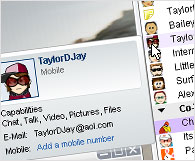
AIM on mobile - one of the first apps in the App Store (2008)
AIM's mobile story is one of the great "almost" moments in tech history. When Apple launched the App Store in July 2008, AIM was one of the very first apps available - and one of the most downloaded. Steve Jobs himself had demoed AIM on the iPhone during early presentations, using it as a showcase for what mobile internet could do.
For a brief, shining moment, it looked like AIM might successfully transition from desktop to mobile. The app was clean, fast, and familiar. Your buddy list was in your pocket. The door sounds played through your iPhone speaker. It felt like the future.
But AIM on mobile exposed a fundamental problem: the desktop messenger paradigm didn't translate to phones. On a desktop, you "signed on" and "signed off" - you were either at your computer or you weren't. On a phone, you were always connected. The concept of "signing on" didn't make sense when you were always reachable. The buddy list - designed for a world where presence was binary - felt clunky on a device that was always in your pocket.
More critically, AIM on mobile arrived at the exact moment that SMS was becoming unlimited. Why open an app to message someone when you could just text them? And then iMessage arrived in 2011, and WhatsApp was already growing explosively internationally, and suddenly AIM wasn't just competing with other messengers - it was competing with the phone itself.
The Decline
AIM didn't die in a single moment. It bled out slowly over nearly a decade, killed by a thousand cuts from every direction.
SMS went unlimited. When carriers started offering unlimited texting plans around 2007-2008, the primary advantage of AIM - free messaging - evaporated. Why sign on to a computer to message someone when you could text them from anywhere?
Google Talk arrived. Launched in 2005 and integrated directly into Gmail, Google Talk offered the same basic functionality as AIM but without the bloat, without the ads, and with the credibility of Google behind it. For the tech-savvy crowd that had been AIM's early adopters, Google Talk was the upgrade.
Facebook Chat changed everything. When Facebook launched its chat feature in 2008, it had something AIM could never match: your real social graph. You didn't need to know someone's screen name or add them to a buddy list. If you were Facebook friends, you could message them. The friction of AIM - finding screen names, adding contacts, managing buddy lists - suddenly felt archaic.
Smartphones killed the desktop paradigm. The iPhone (2007) and Android (2008) moved communication to devices that were always on, always connected, always in your pocket. AIM was built for a world where you sat down at a computer and "went online." That world was disappearing.
AOL's management failures sealed the fate. AOL cycled through strategies - making AIM a social network, adding games, integrating with AIM Pages, launching AIM Phoenix - but none of it worked. The company was too slow, too bureaucratic, and too attached to the desktop model. By the time AOL tried to reinvent AIM for mobile, WhatsApp had 450 million users and iMessage was the default on every iPhone.
On December 15, 2017, AOL officially shut down AIM. The announcement triggered a wave of millennial nostalgia that briefly trended worldwide. People shared their old screen names. They posted screenshots of buddy lists. They mourned a piece of software like it was a childhood friend - because, in a very real sense, it was.
The Legacy: 12 Concepts AIM Invented
AIM has been dead since 2017, but its DNA is in every messaging app, every social network, every digital communication tool you use today. Here are 12 concepts that AIM pioneered or popularized that are now universal standards:
- The Buddy List / Friends List: AIM's buddy list was the first mainstream implementation of a curated contact list with presence indicators. Every messaging app's contact list descends from it.
- Online Presence Indicators: Online, Away, Idle, Invisible - AIM's status system is now in Slack, Discord, Teams, WhatsApp ("last seen"), and every other platform.
- Status Messages / Away Messages: The away message became Facebook's status update, Twitter's tweet, Slack's custom status, and Instagram Stories. All of them are away messages with better formatting.
- Screen Names / Usernames: AIM popularized the concept of a chosen digital identity separate from your real name. Every platform with usernames owes a debt to AIM.
- Typing Indicators: The "is typing..." indicator that causes anxiety on iMessage? AIM did it first.
- Chat Logging: The ability to save conversation history - now standard everywhere - was a third-party AIM feature (via DeadAIM and Trillian) before platforms built it in natively.
- Profile Pages: AIM profiles - with custom HTML, away messages, and buddy info - were proto-social-media profiles. They preceded MySpace profiles by years.
- Chatbots: SmarterChild proved that conversational AI could be mainstream. Every chatbot, every AI assistant, every conversational interface traces its lineage back to SmarterChild on AIM.
- Peer Moderation (Warn System): AIM's warn system was an early experiment in community-driven moderation. Modern report/block systems are its refined descendants.
- Multi-Protocol Messaging: The third-party clients that unified AIM with other networks inspired today's push for messaging interoperability (Matrix, the EU's Digital Markets Act).
- Notification Sounds as Emotional Triggers: AIM's door sounds and message dings proved that audio design could create emotional associations with software. Every app notification sound since is chasing that same Pavlovian response.
- The "Always On" Social Layer: AIM normalized the idea of being perpetually available to your social circle through a digital medium. For better or worse, we now live in the world AIM imagined.
🕰️ Visit the past - still on the Wayback Machine: