Yahoo Chat Wars: Booters, Punters & Room Takeovers
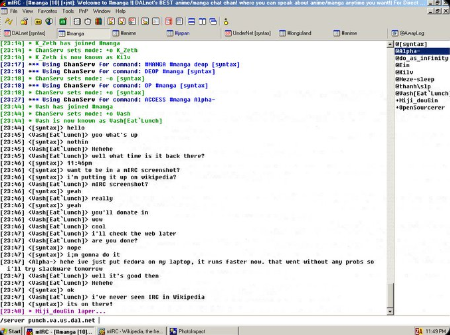
Before Facebook, before Twitter, before Discord - there was Yahoo Chat. And it was absolute chaos. A lawless digital frontier where teenagers and adults alike waged wars over virtual rooms, wielded custom-coded "booters" like weapons, and built empires out of bot armies and social manipulation. If you were online between 1998 and 2008, there's a good chance you witnessed - or participated in - the Yahoo Chat Wars.
This isn't a sanitized corporate history. This is the real story - the booters, the punters, the room takeovers, the ASCII art bombs, the betrayals, and the strange, beautiful communities that somehow thrived in the middle of all that digital warfare. If you lived it, welcome back. If you didn't, buckle up.
💾 A Note on Nostalgia: This article documents a specific era of internet culture from a historical perspective. The tools and techniques described here exploited vulnerabilities in software that no longer exists. This is digital archaeology, not a how-to guide. Yahoo Chat's public rooms were permanently shut down in 2012.

The actual Yahoo Chat banner from 1998 - this is what you saw when you entered the chat rooms
1. Yahoo Chat: The Social Network Before Social Networks
Yahoo Chat launched in 1998 as part of Yahoo's ambitious push to become the internet's everything-portal. At a time when most people were still figuring out what a "homepage" was, Yahoo built one of the first massive-scale, real-time social platforms. And for nearly a decade, it was the place to be online.
The Java Client Era
The original Yahoo Chat ran as a Java applet embedded directly in your web browser. You'd navigate to chat.yahoo.com, wait an eternity for the applet to load over your 56k modem, and suddenly you were connected to thousands of strangers in real time. The interface was spartan - a scrolling text window, a user list on the right, and a text input box at the bottom. No avatars, no rich media, no emoji. Just raw text and screen names.
The Java client was clunky, crashed constantly, and ate RAM like nothing else on your Windows 98 machine. But it didn't matter. The magic wasn't in the software - it was in the people. For millions of users, this was their first experience with real-time, many-to-many communication. It was intoxicating.
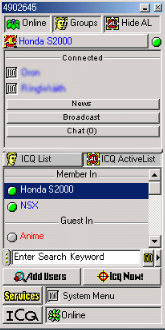
The digital frontier of the late 1990s - Yahoo Chat was the matrix before we knew what the matrix was.
Yahoo Messenger: The Standalone Revolution
In 1999, Yahoo released Yahoo Messenger - a standalone desktop client that changed everything. No more waiting for a Java applet to load. Messenger was fast, lightweight (by 1999 standards), and packed with features the web client never had: buddy lists, offline messaging, file transfers, and eventually webcam support. It became the gateway drug to Yahoo Chat for an entire generation.
Messenger's chat room integration was seamless. You could browse room categories, join public rooms, or create your own - all from the same client you used to IM your friends. The line between private messaging and public chat rooms blurred, and that's where things got interesting.
The Room Categories
Yahoo organized its chat rooms into categories that read like a cross-section of late-90s internet culture:
- Romance - The biggest category by far. Rooms like "Romance:1", "Romance:2" up through the hundreds. This is where most of the drama happened.
- Regional - City and state-specific rooms. "Texas:1", "California:1", "New York City:1". These became digital turf with fierce local loyalty.
- Music - Genre-specific rooms where people argued about Tupac vs. Biggie, debated whether Metallica sold out, and shared (pirated) MP3 links.
- Sports - Game-day rooms that were basically early Twitch chat, minus the video.
- Teen - Rooms designated for younger users. In theory, moderated. In practice, some of the most chaotic rooms on the platform.
- Computers & Internet - Where the hackers, coders, and booter-makers hung out. The arms dealers of the Yahoo Chat Wars.
- Religion - Flame wars that made Reddit look civil.
The Lobby System
Each category had a lobby - a default room you'd land in before choosing a specific room. Lobbies were pure chaos. Hundreds of users cycling in and out, bots spamming links, people advertising their user-created rooms, and the occasional genuine conversation buried under layers of noise. The lobby was the town square of Yahoo Chat - loud, messy, and impossible to ignore.
🖥️ By the Numbers: At its peak around 2001-2003, Yahoo Chat hosted an estimated 4-5 million concurrent users across tens of thousands of rooms. For context, that's more simultaneous users than most modern platforms handle today. Yahoo was running one of the largest real-time communication systems ever built - on early-2000s infrastructure.
User-Created Rooms
Beyond the official categories, any Yahoo user could create their own room. This was where the real culture lived. Rooms with names like "Kool_Kidz_Only_No_Lamez", "Texas Thugz Chat", "Wiccan Circle of Light", or "DBZ Fans Unite" - each one a tiny community with its own rules, regulars, and drama. Creating a room made you the room owner, and that title came with power. Real power. The kind of power that started wars.
User-created rooms had a maximum capacity - typically 50 users, though some room types allowed more. When a popular room filled up, overflow rooms would spawn: "Texas Thugz Chat:2", "Texas Thugz Chat:3", and so on. Managing multiple overflow rooms became a logistical challenge for popular room owners, who had to delegate ops across rooms and maintain consistent rules. Some room owners ran their communities like small businesses, with scheduled events, regular "meetings," and even written rules posted on external websites.
The Sound of Connection
If you were there, you remember the sounds. The door-opening chime when someone joined the room. The door-closing sound when they left. The buzz of a new private message. The specific notification sound when someone on your buddy list came online - that little ascending tone that meant your friend was here, your crush was here, the person you'd been waiting for all day had finally logged on. These sounds became Pavlovian triggers. Even today, decades later, hearing a similar chime can transport a former Yahoo Chat user back to their childhood bedroom, bathed in the glow of a CRT monitor at 2 AM.

Millions of messages, flowing in real time.
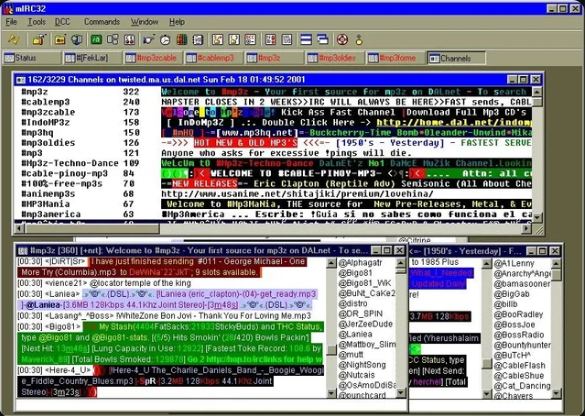
The glow of a CRT at 2 AM - the universal Yahoo Chat experience.
Every room was a world. Every user, a story.
The Profile Game
Every Yahoo user had a profile - a customizable page that displayed your name, age, location, interests, and a short bio. Profiles were the original social media profiles, and people obsessed over them. You'd customize your profile with HTML (Yahoo allowed basic HTML in profiles), add background colors, embedded images, and carefully curated information designed to project exactly the image you wanted. Checking someone's profile before talking to them was standard practice - it was the original "stalking someone's Instagram before a first date."
Profiles also became weapons. During wars, people would screenshot embarrassing profile information and share it in rooms. Fake profiles were created to impersonate enemies. And the "A/S/L" (Age/Sex/Location) exchange that opened virtually every Yahoo Chat conversation was the era's version of a dating app bio - a three-data-point summary that determined whether a conversation would continue or die.
GeoCities hosted the progz download pages; AIM was Yahoo Chat's biggest rival - Wikimedia Commons
2. The Power Structure
To understand the Yahoo Chat Wars, you have to understand the hierarchy. Every room was a tiny kingdom, and the politics were as real and cutthroat as anything in the physical world.

The invisible power grid of Yahoo Chat - every connection was a potential alliance or threat.

Late nights, glowing screens, and the politics of digital power.
The Hierarchy
Every Yahoo Chat room had a rigid social structure, whether its members acknowledged it or not:
Room Owner (Creator) - The person who created the room. They had absolute power: kick anyone, ban anyone, grant or revoke operator status. In user-created rooms, the owner was god. Their screen name appeared with a special icon, and their word was law. Lose your owner status, and you lost everything.
Operators (Ops) - Users granted moderation powers by the room owner. Ops could kick and ban other users, but they served at the pleasure of the owner. Getting "opped" was a status symbol - it meant the owner trusted you. It also made you a target. Ops were the lieutenants in the chat room hierarchy, and the politics of who got ops and who didn't could tear a community apart.
Regulars - The loyal users who showed up every day, knew everyone by screen name, and formed the social backbone of the room. Regulars didn't have technical power, but they had social power. A well-liked regular could influence the owner. A group of regulars could pressure the owner to op or de-op someone. Regulars were the electorate.
Outsiders - Anyone new to the room. Treated with suspicion by default. Were you a genuine new user? A spy from a rival room? A bot? An alt account of someone who'd been banned? Outsiders had to prove themselves before being accepted, and in some rooms, they never were.
The Politics of Ops
Nothing caused more drama in Yahoo Chat than operator status. It was the currency of the realm. Room owners who gave ops too freely were seen as weak - their rooms became chaotic because too many people had kick/ban power. Owners who hoarded ops were seen as tyrants, and their regulars would eventually revolt or leave.
The smartest room owners maintained a careful balance: a small, trusted inner circle of ops, with the implicit promise that loyal regulars might someday be elevated. This kept people coming back. It kept them loyal. It was, in retrospect, a masterclass in community management - invented by teenagers on dial-up connections.
Alliances and Rivalries
Rooms didn't exist in isolation. Regulars from one room would visit others, forming cross-room friendships and rivalries. Room owners would form alliances - mutual defense pacts where if one room was attacked, the other would send reinforcements. These alliances had names, private chat rooms for coordination, and sometimes even websites hosted on GeoCities or Angelfire.
Alliance websites were a phenomenon unto themselves. Built with the garish aesthetic of early-2000s web design - animated GIFs, tiled backgrounds, MIDI music that auto-played on page load, and visitor counters proudly displaying triple-digit numbers - these sites served as the public face of chat room alliances. They'd list member rooms, post "rules of engagement," display trophies from successful defenses, and maintain "enemy lists" of rival crews and their known screen names.
And where there were alliances, there were rivalries. Two room owners beefing over a user who switched rooms. A de-opped regular starting their own competing room and poaching members. Regional pride - the Dallas room vs. the Houston room. These rivalries simmered for weeks, months, sometimes years. And when they boiled over, the weapons came out.
The Alt Account Game
No discussion of Yahoo Chat's power dynamics is complete without mentioning alt accounts. Almost everyone had multiple Yahoo accounts - "alts" - used for different purposes. Your main account was your public identity, the one your friends knew. But you'd also have alts for spying on rival rooms without being recognized, for testing whether you'd been banned, for starting fresh if your main account's reputation was damaged, or simply for separating different social circles.
The alt account game created a layer of paranoia that permeated every interaction. When a new user joined a room, the first question in everyone's mind was: "Whose alt is this?" Experienced users could sometimes identify alts by typing patterns, vocabulary, or behavior. Accusing someone of being an alt - "You're just [screen name]'s alt!" - was a common accusation that could derail conversations for hours. The concept of a single, verified online identity that modern platforms take for granted simply didn't exist in Yahoo Chat. Everyone was potentially everyone else.

Yahoo Messenger banner - archived from the original Yahoo servers via Wayback Machine
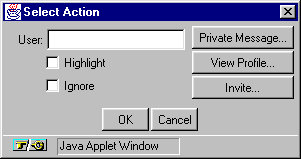
Yahoo Chat actions menu (archived 2000) - booters exploited the protocol behind this interface
3. The First Booters
The Yahoo Chat Wars didn't start with sophisticated hacking tools. They started with curiosity, spite, and a protocol that was never designed to withstand adversarial users. The first booters were crude, ugly, and devastatingly effective.
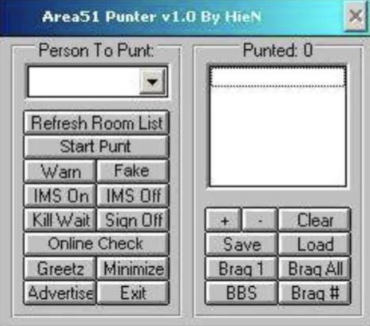
Area51 Punter v1.0 by HieN - an actual Yahoo punter. "Person To Punt" dropdown, "Start Punt" button, "Punted: 0" counter, plus Warn, Fake, IMS On/Off, Kill Wait, Greetz, Save/Load, and "Braq All" buttons. This is the real thing.
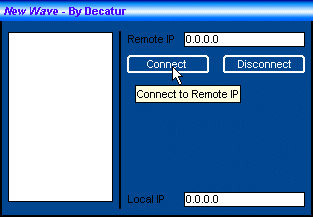
Lines of code that could crash a stranger's computer from across the country - the booter era had begun.
The YMSG Protocol
Everything starts with the protocol. Yahoo Messenger used a proprietary protocol called YMSG (Yahoo Messenger Protocol) to handle all communication - login, messaging, chat rooms, file transfers, webcam, everything. YMSG was a binary protocol that sent data in structured packets between the client and Yahoo's servers.
The problem? YMSG was designed for functionality, not security. Yahoo's engineers built it to work, not to withstand attack. The protocol had minimal input validation, weak authentication for many operations, and several packet types that the client would process without proper bounds checking. For anyone willing to reverse-engineer the protocol - and plenty of people were - it was a goldmine of exploits.
How Booters Actually Worked
A "booter" was a program that sent specially crafted malformed YMSG packets to a target user through Yahoo's servers. These packets exploited vulnerabilities in how Yahoo Messenger's client parsed incoming data. The most common attack vectors included:
- Buffer overflow packets - Sending a packet with a field that exceeded the expected length, causing the client to write data beyond its allocated memory buffer. This would crash Yahoo Messenger instantly, and in some cases, crash the entire operating system (especially on Windows 98/ME).
- Malformed conference invites - Yahoo's conference (group chat) feature had particularly weak validation. Sending a conference invite with corrupted header data would crash the recipient's client the moment it tried to parse the invitation.
- Recursive packet loops - Some booters sent packets that tricked the client into entering an infinite processing loop, freezing the application and sometimes the entire system.
- Status message exploits - Custom status messages with specific character sequences or excessive length could crash clients that tried to render them in the buddy list.
The key insight was that you didn't need to hack Yahoo's servers. You just needed to send data through Yahoo's servers that would break the client on the other end. Yahoo's servers were just the delivery mechanism - the weapon was the packet itself.
Boot vs. Punt: Know the Difference
⚡ Boot vs. Punt - The Critical Distinction:
Boot: Crashing the target's Yahoo Messenger client entirely. The application would freeze, throw an error, or simply disappear. The user would have to restart Messenger and log back in. A hard boot might even require a system restart. This was the nuclear option.
Punt: Disconnecting the target from a specific chat room without crashing their client. The user would suddenly find themselves removed from the room but still logged into Messenger. Punting was more surgical - you could remove someone from a room without taking down their whole session. It was the precision strike to the boot's carpet bombing.
The Arms Race
What followed was a classic arms race. Yahoo would patch a vulnerability, and within days - sometimes hours - someone in the "Computers & Internet" rooms or on underground forums would find a new one. Each generation of booters was more sophisticated than the last:
First Generation (1999-2000): Simple packet senders. Usually written in Visual Basic 6. One exploit, one button. Names like "Yahoo Punter v1.0" with garish interfaces featuring flames and skulls. You'd paste in a screen name, click "BOOT", and hope for the best.
Second Generation (2001-2003): Multi-exploit tools. Written in VB6 or Delphi. Featured multiple boot methods so if one was patched, you could try another. Tools like Yahoo Booter Pro, Mass Punter, and Super Booter became infamous. Some had built-in packet sniffers to capture and analyze YMSG traffic in real time.
Third Generation (2003-2006): Integrated warfare suites. These weren't just booters - they were complete Yahoo Chat manipulation platforms. Room flooding, mass joining, bot management, booter, punter, webcam capture, and IP logging all in one application. The Swiss Army knives of Yahoo Chat warfare.
The people who built these tools were, in many cases, self-taught programmers who learned to code specifically to win chat room wars. They reverse-engineered a proprietary binary protocol, wrote network code, built GUIs, and distributed their software - all before they were old enough to drive. The Yahoo Chat Wars were, accidentally, one of the largest informal computer science education programs in history.
4. Room Takeovers
If booters were the weapons of the Yahoo Chat Wars, room takeovers were the battles. A successful room takeover was the ultimate power move - seizing control of an established room from its owner and installing your own people. It was hostile corporate acquisition meets medieval siege warfare, played out in real time over dial-up connections.
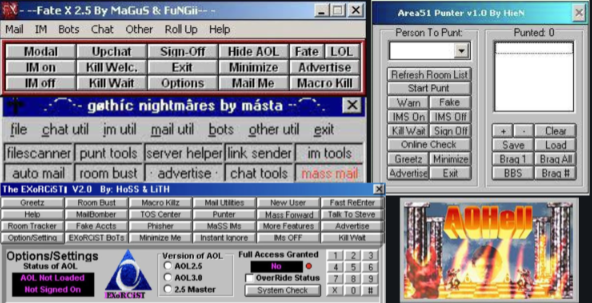
The arsenal in action: Fate X 2.5 (top left) with Upchat, Sign-Off, Hide AOL, Macro Kill; Area51 Punter (top right); Gothic Nightmares (middle) with filescanner, punt tools, mass mail; The Exorcist V2.0 (bottom left) with Room Bust, MailBomber, TOS Center; and AOHell (bottom right). This is what a room takeover operator's desktop looked like.

The room takeover - part technical exploit, part social engineering, all chaos.
The Anatomy of a Room Takeover
A well-executed room takeover was a coordinated operation with multiple phases:
Phase 1: Reconnaissance. Scout the target room. Identify the owner, the ops, the regulars. Note when the owner is usually online and offline. Figure out who the weak links are - which ops might be turned, which regulars are disgruntled. This phase could take days or weeks.
Phase 2: Staging. Prepare your bot army. You needed dozens, sometimes hundreds, of fake Yahoo accounts ready to go. Each account needed to be "aged" - freshly created accounts were sometimes restricted from joining rooms. Smart operators created accounts weeks in advance and logged them in periodically to build history.
Phase 3: The Strike. This was the moment of truth. The attack typically unfolded like this:
- Flood the room with your bot accounts, filling up user slots
- Boot the room owner using your best exploit
- Immediately boot all ops before they can react
- With the owner and ops gone, your bots now outnumber the remaining users
- If the room was user-created, ownership could sometimes transfer or the room would become unmoderated - either way, you now controlled it
- Use your bots to kick any remaining hostile users
- Install your own people as the new power structure
Phase 4: Defense. Holding a room was harder than taking it. The original owner would come back with their own bots and booters. You had to maintain a constant bot presence, keep your booters ready, and be prepared for counter-attacks that could come at any hour.
The Tools of the Trade
Room takeovers spawned their own ecosystem of specialized tools:
- Room Jacker - Automated the entire takeover process. Input the room name, point it at your bot list, and it would handle the flooding, booting, and occupation automatically.
- Mass Joiner - Could log in and join a room with dozens of bot accounts simultaneously. Speed was critical - you needed to fill the room before the owner could react.
- Bot Manager - A control panel for your bot army. Send commands to all bots at once: join a room, leave a room, say something, vote-kick a user. Some bot managers could handle hundreds of accounts from a single interface.
- Account Creator - Automated the process of creating new Yahoo accounts. Before effective CAPTCHA, you could generate hundreds of accounts per hour.
The Social Engineering Angle
Not every takeover was a brute-force assault. Some of the most devastating takeovers used social engineering - the art of manipulation. The playbook was devious:
Step one: Create a clean alt account with no connection to your main identity. Step two: Join the target room as a "new user." Be friendly, be helpful, be present. Become a regular over days or weeks. Step three: Befriend the room owner. Gain their trust. Step four: Get opped. Step five: Wait for the right moment - when the owner is offline and you're the only op - then execute the takeover from the inside. Boot the other ops, flood with bots, change the room's power structure.
The betrayal was the point. In Yahoo Chat culture, an inside-job takeover was considered more impressive than a brute-force one. It demonstrated patience, social skill, and ruthlessness. The victim wasn't just outgunned - they were outplayed.
Takeover Crews
The most prolific room takeovers weren't solo operations - they were carried out by organized crews. These groups had names, reputations, and internal hierarchies that mirrored the rooms they attacked. Crews would coordinate through private Yahoo Chat rooms, AIM, IRC, or early forums. They'd share exploits, pool bot armies, and plan operations like military campaigns.
Some crews specialized in specific room categories - one group might dominate the Romance rooms while another controlled the Regional rooms. Turf wars between crews were some of the most intense conflicts in Yahoo Chat history, with battles raging across dozens of rooms simultaneously.
5. Chat Flooding & ASCII Art Bombs
Not every act of Yahoo Chat warfare was about power or territory. Sometimes it was about pure, unadulterated chaos. Chat flooding was the art of disruption - turning a functioning chat room into an unreadable wall of text, color, and noise. And for a certain breed of internet troll, it was an art form.

The scroll - when code became a weapon of mass disruption.

ASCII art bombs could fill an entire chat window in seconds.
The Text Repeater
The simplest form of flooding: a script that sent the same message to a chat room hundreds of times per second. The message could be anything - an insult directed at the room owner, a recruitment pitch for a rival room, or just the letter "A" repeated into infinity. The goal was simple: make the chat unusable. Legitimate messages would be buried under an avalanche of spam, scrolling off the screen before anyone could read them.
Text repeaters were the gateway drug of Yahoo Chat warfare. Almost everyone who got into booters and room takeovers started with a simple text repeater. They were easy to build - a few lines of Visual Basic code and a basic understanding of the YMSG protocol - and the results were immediately visible and satisfying (if you were the one doing the flooding).
ASCII Art Bombs
If text repeaters were the blunt instrument, ASCII art bombs were the creative expression of chat room destruction. These were massive blocks of text art - skulls, middle fingers, dragons, logos, profanity - designed to fill the entire chat window in a single message. A well-crafted ASCII art bomb could be dozens of lines tall and wide enough to force horizontal scrolling.
The best ASCII artists in the Yahoo Chat community were genuinely talented. They'd spend hours crafting intricate designs that would display perfectly in Yahoo's chat font. Some created "animated" ASCII art - a series of slightly different frames sent in rapid succession that created the illusion of movement. A skull whose jaw opened and closed. A middle finger that appeared to rise from the bottom of the screen. It was vandalism elevated to performance art.
Color Code Exploits
Yahoo Chat supported basic text formatting through escape codes - you could change text color, size, and font. Naturally, people found ways to weaponize this. Specific combinations of color codes and formatting tags could:
- Render as invisible text that took up massive amounts of space, creating blank "walls" in the chat
- Crash older versions of Yahoo Messenger that couldn't handle malformed formatting tags
- Create seizure-inducing rapid color changes (this was genuinely dangerous and deeply irresponsible)
- Exploit rendering bugs to make text appear outside the chat window or overlap the user interface
The "Scroll"
In Yahoo Chat slang, getting "scrolled" meant that a flooder had made the chat move so fast that you couldn't read anything. A good scroll was relentless - the moment you thought it was over, another wave would hit. Experienced users learned to recognize the signs: a sudden burst of identical messages, the chat window jumping, the scrollbar shrinking to a tiny sliver as hundreds of lines piled up.
The counter to scrolling was the ignore feature - you could block messages from specific users. But flooders using bot armies could scroll from dozens of different accounts simultaneously. By the time you ignored one, ten more had taken its place. It was whack-a-mole with a broken mallet.
Flood Defense Strategies
Experienced room communities developed their own anti-flood strategies. The most common was the "mass ignore" - when a flood started, regulars would quickly share the screen names of the flooding accounts so everyone could ignore them simultaneously. Some rooms had designated "flood watchers" who would monitor for the early signs of an attack and alert the ops.
More technical defenses included third-party Yahoo Messenger plugins that could auto-ignore accounts sending messages above a certain rate, or that filtered out messages containing known flood patterns. Some room owners ran their own bots that would automatically kick accounts exhibiting flood behavior - fighting automation with automation.
The most extreme defense was the room lock - closing the room to new users during an attack. This kept the flooders' reinforcements out but also prevented legitimate new users from joining. It was the chat room equivalent of pulling up the drawbridge during a siege.

Defense was as technical as offense - auto-kick scripts, flood filters, and room locks became essential tools.
🎨 Creative Floods: Not all floods were mindless spam. Some flooders developed signature styles - one might flood exclusively with Tupac lyrics, another with lines from "The Matrix," another with elaborate insults written in iambic pentameter. There was a strange creativity to it, a desire to be recognized even in the act of destruction. "Oh, that's the Shakespeare flooder" was a sentence that actually made sense in 2002.
6. The Webcam Era
Around 2002-2003, Yahoo Messenger added integrated webcam support, and Yahoo Chat was never the same. Suddenly, the anonymous text-based world had faces. You could see the person you were talking to - or fighting with. It added an entirely new dimension to both the community and the warfare.

When webcams came to Yahoo Chat, the anonymous internet got its first face - and its first privacy crisis.
Webcam Culture
Webcam-enabled rooms became their own subculture. "Cam rooms" were rooms where having your webcam on was expected or required. They developed their own etiquette: you'd "cam up" to show you were real, rate each other's setups, and the quality of your webcam became a status symbol. Early webcams produced grainy, low-resolution, low-framerate video that looked like security footage from a haunted building - but it was live, and that was revolutionary.
The social dynamics shifted dramatically. In text-only rooms, your identity was your words and your screen name. In cam rooms, appearance mattered. Attractive users got more attention. People curated their backgrounds, their lighting, their angles - the precursor to every Instagram and TikTok behavior we see today, happening a decade earlier in Yahoo Chat rooms.
Webcam Cappers
Where there were webcams, there were people recording them without consent. Webcam cappers used tools that could capture and save another user's webcam feed. The captured video could be saved locally, shared in other rooms, or posted on early file-sharing sites. This was a serious privacy violation that Yahoo was slow to address.
Capping tools exploited the way Yahoo transmitted webcam data - the video stream was sent peer-to-peer in many cases, which meant the capper could intercept it directly. Some tools could capture feeds from multiple users simultaneously, creating archives of webcam footage that the subjects never consented to and often didn't know existed.
Voice Chat and Voice Bombers
Yahoo also added voice chat to rooms, allowing users to speak through their microphones. Voice-enabled rooms were chaotic in a whole new way - imagine a room of 50 people where anyone could grab the mic. Voice bombers emerged: tools that could blast loud, distorted audio through the voice channel, or play pre-recorded sounds on loop. Imagine trying to have a conversation while someone blasts an air horn directly into the voice channel for ten minutes straight.
Voice rooms also introduced a new form of social hierarchy. Users with good microphones and confident speaking voices gained status. "Mic bullies" would dominate the voice channel, talking over everyone else. The intersection of voice, video, and text created a rich, chaotic communication environment that wouldn't be replicated until Discord arrived over a decade later.
The Privacy Reckoning
The webcam era forced Yahoo Chat users to confront privacy in ways the text-only era never had. In text rooms, you were anonymous - just a screen name and whatever you chose to share. With webcams, you were visible. Your face, your room, your life was on display. And unlike modern platforms where privacy settings are granular and well-understood, Yahoo's webcam implementation was crude. Once you turned your cam on, you had limited control over who could see it or what they did with the feed.
The webcam era was, in many ways, a preview of the privacy challenges that would define the social media age. The tension between the desire to be seen and the risk of being exposed, between authenticity and vulnerability, between connection and exploitation - all of it played out first in Yahoo Chat's cam rooms, years before Facebook, Instagram, or TikTok made these tensions mainstream.
📹 The Cam Room Etiquette: Unwritten rules governed cam rooms. You were expected to "cam up" if you wanted to stay - lurking with your cam off was frowned upon. You didn't screenshot or cap someone's feed without permission (though this rule was constantly violated). You complimented people's setups. You didn't comment on someone's appearance in cruel ways - at least not in the room itself. Private messages were another story entirely. These norms were the precursors to the content creator etiquette that governs platforms like Twitch and YouTube today.
Yahoo Messenger promo (archived)

Yahoo Chat 88x31 badge - the era of link buttons
7. The Bot Armies
If booters were the swords of the Yahoo Chat Wars, bot armies were the soldiers. No serious chat warrior operated alone - they commanded fleets of automated accounts that could flood rooms, hold territory, vote-kick enemies, and project power across the entire platform. Building and maintaining a bot army was both a technical challenge and a logistical operation.

Hundreds of accounts, one controller.

Bot management was a full-time job.

The puppet masters of Yahoo Chat.
Account Creation at Scale
Every bot needed a Yahoo account, and in the early days, creating accounts was trivially easy. Yahoo's registration page had minimal verification - no phone number, no email confirmation, and CAPTCHA was either nonexistent or laughably simple. Account creation tools could generate hundreds of accounts per hour, each with a randomized screen name, fake profile information, and a password stored in a local database.
The screen names themselves became an art form. Some operators gave their bots sequential names: army_bot_001 through army_bot_500. Others used random generators to create names that looked vaguely human: jessica_tx_2003, mike_cali_dude, sweetgirl_nyc. The goal was to make the bots blend in - at least long enough to get into a room before anyone noticed.
Bot Management Infrastructure
Managing hundreds of bot accounts required serious tooling. The best bot managers were sophisticated applications that could:
- Simultaneous login - Log in to dozens or hundreds of Yahoo accounts at once, each maintaining its own YMSG session
- Room coordination - Send all bots to a specific room on command, or distribute them across multiple rooms
- Chat automation - Make bots send messages, respond to triggers, or simulate conversation to appear human
- Vote-kick coordination - Yahoo had a vote-kick feature where users could vote to remove someone from a room. With enough bots, you could vote-kick anyone instantly
- Proxy rotation - Route each bot through a different proxy server to avoid IP-based bans
- Auto-reconnect - If a bot was kicked or disconnected, automatically log back in and rejoin the room
Running a large bot army required significant computing resources by early-2000s standards. Each bot maintained an active TCP connection to Yahoo's servers, consumed memory, and generated network traffic. Serious operators ran their bots on dedicated machines - sometimes multiple machines - and managed them through custom control panels that looked like mission control.
The Bot Economy
Where there's demand, there's a market. A thriving underground economy emerged around Yahoo Chat bots and warfare services:
- Bot accounts for sale - Pre-created, aged Yahoo accounts sold in bulk. Prices ranged from a few cents per account for fresh ones to several dollars for aged accounts with established profiles.
- Room takeover services - Pay someone to take over a room for you. Prices varied based on the room's size and how well-defended it was.
- Bot army rental - Rent access to someone else's bot army for a specific operation. Hourly or daily rates.
- Custom tool development - Commission a programmer to build you a custom booter, bot manager, or room takeover tool. The best developers had waiting lists.
- Protection services - Pay someone to defend your room from takeovers. A digital protection racket.
Most transactions happened through PayPal or, for the truly paranoid, mailed cash or money orders. The amounts were small by adult standards - $5 here, $20 there - but for the teenagers who made up much of the Yahoo Chat Wars community, it was real money. Some enterprising young programmers made hundreds of dollars a month selling tools and services. It was, for many, their first experience with entrepreneurship.
The Ethics of the Bot Economy
The bot economy existed in a moral gray zone that its participants rarely examined. On one hand, these were people building software, providing services, and engaging in commerce - fundamentally entrepreneurial activities. On the other hand, the "products" were tools for harassment, disruption, and the violation of a platform's terms of service. Many participants were minors who didn't fully grasp the legal or ethical implications of what they were doing.
Some bot operators drew lines. They wouldn't sell services to people who intended to target vulnerable communities. They wouldn't help with doxing or real-world harassment. Others had no such scruples and would work for anyone who could pay. The bot economy was, in miniature, a preview of the ethical debates that would later consume the tech industry - questions about the responsibility of tool-makers for how their tools are used, about the line between disruption and destruction, about the moral obligations of people who build powerful things.
💰 The Going Rates (circa 2003):
100 fresh Yahoo accounts: $5-10
100 aged accounts (30+ days): $15-25
Room takeover service (small room): $10-20
Room takeover service (large/defended room): $30-50
Custom booter development: $50-200
Bot army rental (24 hours): $10-15
Room protection (monthly): $20-40
These prices seem trivial now, but adjusted for the age of the participants and the era's purchasing power, they represented significant sums. A $50 custom booter commission was a week's allowance for many of these kids.

The Yahoo Messenger icon - instantly recognizable to a generation of chat users
8. Famous Yahoo Chat Wars
The Yahoo Chat Wars weren't one conflict - they were thousands of overlapping battles, feuds, and rivalries playing out simultaneously across the platform. But some conflicts rose above the noise, becoming legendary within the community. These were the wars that defined eras, destroyed friendships, and are still talked about in nostalgic corners of the internet today.
The battles raged through the night - fueled by Mountain Dew, dial-up connections, and teenage fury.
The Regional Room Wars
Some of the most intense and long-lasting conflicts were between regional rooms. City pride translated directly into chat room warfare. The Dallas rooms vs. the Houston rooms. New York vs. New Jersey. Chicago vs. Detroit. Los Angeles vs. everyone. These weren't just about chat rooms - they were about identity. Attacking someone's city room was attacking their city, and people took it personally.
Regional wars could last for months. One side would take over the other's room, hold it for a few days, then lose it in a counter-attack. Regulars from both sides would trash-talk in neutral rooms, recruit allies, and plan their next offensive. The wars spilled over into private messages, profile comments, and even real-life threats (almost never acted upon, but dramatic nonetheless).
The Romance Room Drama
The Romance category was the largest on Yahoo Chat, and it was a soap opera that never stopped airing. The drama was legendary: love triangles between users who'd never met in person, jealous rages when someone's "Yahoo boyfriend" was seen chatting in another room, elaborate catfishing schemes, and breakups that played out in public chat for everyone to witness.
But the Romance rooms also produced some of the most vicious wars. When relationships went bad - and they always went bad - the fallout was nuclear. A scorned user might recruit a booter crew to destroy their ex's favorite room. Room owners who played favorites in romantic disputes would find their rooms under siege. The intersection of real emotions and digital weapons was volatile and unpredictable.
The Teen Room Chaos
Yahoo's Teen rooms were supposed to be safe spaces for younger users. In reality, they were some of the most chaotic rooms on the platform. The combination of teenage energy, minimal moderation, and easy access to booter tools created a perfect storm. Teen rooms were constantly being flooded, taken over, and fought over. The wars in teen rooms were often the most personal - these were kids from the same schools, the same neighborhoods, bringing real-world social dynamics into the digital space.
The IRC Crossover
Many of the most skilled Yahoo Chat warriors also had roots in IRC (Internet Relay Chat), which had its own long history of channel wars, botnets, and DDoS attacks. IRC veterans brought sophisticated techniques to Yahoo Chat - better scripting skills, more advanced network knowledge, and a culture of organized warfare that Yahoo's more casual user base wasn't prepared for.
The crossover went both ways. Techniques developed for Yahoo Chat warfare - particularly around protocol exploitation and bot management - were adapted for use on IRC. And some of the biggest conflicts involved crews that operated on both platforms simultaneously, fighting wars across Yahoo Chat and IRC at the same time.
The Forum Connection
The Yahoo Chat Wars didn't stay contained to Yahoo. A sprawling ecosystem of web forums grew up around the conflict. Sites hosted on free platforms like InvisionFree, ProBoards, and phpBB installations on cheap shared hosting became the war rooms where strategies were planned, alliances were forged, and tools were distributed.
These forums had their own culture. Members would post "war reports" - detailed accounts of room takeovers, complete with timestamps, participant lists, and screenshots. Booter developers would release new tools with changelogs and feature lists, like legitimate software releases. Tutorial sections taught newcomers how to use the tools, reverse-engineer protocols, and execute takeovers. It was an underground university of hacking, social engineering, and digital warfare.
The forums were the war rooms - strategies planned, tools shared, victories celebrated.
The wars spanned platforms - Yahoo, IRC, AIM, and dozens of forums.
The Reputation Economy
In the Yahoo Chat Wars, your reputation was everything. Screen names became brands. A known booter developer could walk into any room and command respect - or fear. A crew with a reputation for successful takeovers could sometimes win without firing a shot; room owners would simply surrender rather than face the inevitable.
Reputation was built through action and maintained through presence. You had to be seen, had to be active, had to keep winning. A crew that went quiet for too long would be seen as weak, inviting challenges from upstarts. It was an exhausting, 24/7 commitment to maintaining status in a world where status was the only currency that mattered.
🏴 The Unwritten Rules: Despite the chaos, the Yahoo Chat Wars had unwritten codes of conduct. You didn't boot someone during a genuine personal crisis. You didn't use real-life information (addresses, phone numbers, employers) as a weapon - that was called "doxing" even before the term was widely known, and it was considered crossing a line. You didn't attack rooms dedicated to grief support or serious topics. These rules weren't always followed, but they existed, and violating them could turn the entire community against you.
9. Yahoo's Response
Yahoo wasn't blind to the chaos consuming its chat platform. Over the years, the company deployed a series of countermeasures in an increasingly desperate attempt to regain control. It was a cat-and-mouse game that Yahoo was destined to lose - not because the attackers were smarter, but because the fundamental architecture of the platform made it nearly impossible to defend.
Yahoo's security team fought a war on every front - and lost on most of them.
Protocol patches bought time, but never solved the fundamental problem.
The CAPTCHA Wars
Yahoo's first major defensive move was implementing CAPTCHA on account creation and, eventually, on chat room entry. The early CAPTCHAs were simple distorted text images that were trivially easy for OCR (Optical Character Recognition) tools to solve. Bot operators adapted within days, integrating CAPTCHA solvers directly into their account creation tools.
Yahoo escalated, making CAPTCHAs progressively harder. The images became more distorted, added noise, used overlapping characters. But each escalation was met with better OCR tools, and eventually with CAPTCHA-solving services - websites where real humans would solve CAPTCHAs for fractions of a cent each. You'd send the CAPTCHA image to the service via API, a human in a developing country would solve it, and the answer would come back in seconds. The bot army creation pipeline barely slowed down.
Protocol Hardening
Yahoo's engineering team worked to harden the YMSG protocol against the exploits that booters relied on. They added input validation, fixed buffer overflows, implemented rate limiting on certain packet types, and added encryption to some communications. Each patch killed a generation of booters - for a while.
But the protocol was fundamentally flawed. It had been designed for a friendly environment and retrofitting security onto it was like adding armor to a bicycle. Every patch introduced new complexity, and new complexity meant new attack surface. The booter developers were often faster at finding new vulnerabilities than Yahoo was at patching old ones.
IP Banning and Rate Limiting
Yahoo implemented IP-based banning - if an IP address was associated with abusive behavior, it would be blocked from accessing chat services. This was effective against casual troublemakers but useless against serious operators who used proxy servers, VPNs, or compromised machines to route their traffic through different IP addresses.
Rate limiting - restricting how many messages a user could send per minute, how many rooms they could join, how many accounts could log in from the same IP - helped reduce the impact of flooding and bot armies but also frustrated legitimate users. The collateral damage of Yahoo's defensive measures was a degraded experience for everyone.
The Slow Decline
By the mid-2000s, Yahoo Chat was in decline. The constant warfare had driven away casual users. The platform's reputation was tarnished by media reports focusing on predatory behavior in chat rooms. Yahoo's corporate attention had shifted to other products. The chat rooms received less development, fewer resources, and less moderation.
In 2005, Yahoo shut down user-created chat rooms, citing the inability to moderate them effectively. This was a devastating blow to the community - user-created rooms were where most of the culture lived. The official category rooms continued, but the soul of Yahoo Chat was gone.
In 2012, Yahoo shut down public chat rooms entirely. The official statement cited low usage and the shift to other communication platforms. But everyone who'd been there knew the real reason: Yahoo had lost the war. The platform that had once hosted millions of concurrent users had been consumed by the very chaos that made it exciting.
📉 The Timeline of Decline:
1998: Yahoo Chat launches. The golden age begins.
2001-2003: Peak usage. Millions of concurrent users. The wars rage at full intensity.
2004: Media scrutiny intensifies. Yahoo begins aggressive moderation.
2005: User-created rooms shut down. Mass exodus of users.
2008: Yahoo Messenger redesign removes many chat features. Community fragments.
2012: Public chat rooms permanently closed. An era ends.
2018: Yahoo Messenger itself is discontinued. The last light goes out.
10. The Human Side
It's easy to focus on the warfare - the booters, the bots, the takeovers. But that's only half the story. For every room that was taken over, there were hundreds that hummed along peacefully, filled with people who genuinely connected with each other. The Yahoo Chat Wars were the dramatic foreground, but the human connections were the quiet, enduring background.

Behind every screen name was a real person - and some of those connections lasted a lifetime.
Real Friendships, Real Love
Thousands of people formed genuine, lasting friendships in Yahoo Chat rooms. People who met as strangers in a regional room and ended up talking every day for years. Friend groups that organized real-life meetups - driving hours to meet the people they'd only known as screen names. Some of those friendships persist to this day, two decades later, maintained through Facebook, Discord, and group texts.
And yes, people fell in love. Yahoo Chat marriages were a real phenomenon. Couples who met in Romance rooms, moved to private messages, graduated to phone calls, and eventually met in person. Some of those relationships didn't survive the transition from digital to physical. But many did. There are couples today who've been married for 20+ years who met in a Yahoo Chat room, and they'll tell you the story with a mix of embarrassment and genuine warmth.
Communities Within the Chaos
The most resilient Yahoo Chat communities were the ones that existed despite the wars, not because of them. Support groups for people dealing with illness, grief, or addiction. Hobby rooms where people shared their passion for gardening, cooking, or model trains. Study groups where college students helped each other with homework. Religious and spiritual communities that provided genuine comfort.
These communities developed their own defense mechanisms. Tight-knit groups of regulars who knew each other well enough to spot intruders immediately. Room owners who were vigilant about ops and quick to kick troublemakers. Some rooms maintained "safe lists" - only users on the list could join. They built walls around their communities and defended them fiercely, not with booters and bots, but with social cohesion and shared purpose.
The Impact on Regular Users
For users who just wanted to chat, the wars were a constant annoyance at best and a traumatic experience at worst. Imagine logging into your favorite room - the one where you'd spent months building friendships - only to find it flooded with bots, your friends scattered, and the room owner you trusted replaced by strangers. It happened all the time, and it drove people away from the platform in droves.
The wars also created a culture of paranoia. Was that new user a genuine person or a spy? Was your friend's account really them, or had it been compromised? Was the room owner going to sell out to a takeover crew? Trust was hard to build and easy to destroy, and the constant threat of attack kept everyone on edge.
The Nostalgia Factor
Despite everything - the chaos, the drama, the booters, the betrayals - there's a deep, genuine nostalgia for Yahoo Chat among the people who were there. It was messy and often toxic, but it was also alive in a way that modern social media rarely is. There was no algorithm deciding what you saw. No influencers performing for followers. No corporate content strategy. Just people, in real time, being themselves - for better and for worse.
Yahoo Chat was the internet before the internet grew up. It was the Wild West before the railroads came. It was chaotic, dangerous, creative, cruel, kind, and utterly, irreplaceably human. Nothing like it will ever exist again, because the conditions that created it - a new technology, a naive platform, a generation of users discovering real-time communication for the first time - can never be replicated.
Today, former Yahoo Chat users find each other in Facebook groups with names like "You Know You Were Addicted to Yahoo Chat If..." and "Yahoo Chat Memories." They share screenshots, swap stories, and occasionally reconnect with people they haven't spoken to in 15 or 20 years. The conversations are tinged with the bittersweet recognition that they lived through something unique - a moment in internet history that will never come again.
What Yahoo Chat Taught Us
For all its flaws, Yahoo Chat was an education. It taught a generation of users about online identity, digital privacy, community management, and the complex dynamics of anonymous communication. It taught people that the internet was not just a tool but a place - a place where real things happened to real people, where actions had consequences, and where the line between "online" and "real life" was thinner than anyone expected.
The kids who grew up in Yahoo Chat rooms became the adults who built the modern internet. They carried the lessons - both good and bad - into every platform, every community, every online interaction that followed. When a Discord moderator carefully manages their server's permissions, they're applying lessons that were first learned (the hard way) in Yahoo Chat. When a Twitch streamer deals with a chat raid, they're facing a descendant of the room takeover. The DNA of Yahoo Chat is woven into the fabric of online communication.
Every modern platform carries Yahoo Chat's DNA.
The lessons learned in chat rooms shaped careers.
Self-taught coders became the industry's backbone.
💬 If You Were There: You remember the sound of the door opening when someone joined the room. You remember the thrill of seeing your crush's screen name come online. You remember the panic when the room started scrolling and you knew a flood was coming. You remember staying up until 3 AM on a school night because the conversation was too good to leave. You remember the friendships that felt as real as any you'd made in person - because they were.
Yahoo Chat is gone. But if you were there, it's still a part of you. And somewhere, on some Discord server or Reddit thread or Facebook group, the people you knew are still out there, still remembering, still carrying a piece of that chaotic, beautiful, impossible time.
Conclusion: Digital Archaeology
The Yahoo Chat Wars were more than just internet drama. They were a proving ground for an entire generation of technologists. The kids who reverse-engineered YMSG went on to become security researchers, software engineers, and network architects. The room owners who managed communities of hundreds learned leadership skills that served them in corporate careers. The social engineers who executed inside-job takeovers became salespeople, negotiators, and (hopefully reformed) social media strategists.
The tools and techniques of the Yahoo Chat Wars - protocol exploitation, bot networks, social engineering, DDoS-style attacks - presaged the cybersecurity landscape we live in today. The same fundamental dynamics play out now at a much larger scale: attackers find vulnerabilities, defenders patch them, attackers adapt. The cat-and-mouse game that Yahoo lost is the same game that every platform, every company, every government is playing right now.
Yahoo Chat is gone, but its legacy lives on in every chat platform that followed. Discord's moderation tools exist because of the lessons Yahoo learned too late. Twitch's chat filtering exists because of the flooding techniques pioneered in Yahoo rooms. Every CAPTCHA you solve is a descendant of Yahoo's desperate attempts to stop bot armies. The internet remembers, even when the platforms don't.
The Parallel to Modern Platforms
Look at any modern platform and you'll see echoes of Yahoo Chat. Discord servers have owners, moderators, and roles - a direct descendant of Yahoo's owner/ops/regular hierarchy. Twitch chat has slow mode and subscriber-only mode - evolved versions of Yahoo's rate limiting and room locks. Reddit's subreddit wars, brigading, and mod drama are the spiritual successors to Yahoo Chat room takeovers. Even the concept of "raiding" - sending a flood of users from one community to another - traces its lineage directly back to the Yahoo Chat Wars.
The difference is that modern platforms learned from Yahoo's mistakes. They built moderation tools from the start. They implemented robust authentication. They hired trust and safety teams. They didn't wait for the wars to start before building defenses. Yahoo Chat was the cautionary tale that shaped how every subsequent platform approached community management and security.
A Lost World
There's no archive of Yahoo Chat. No Wayback Machine snapshot of a conversation in Romance:1 at 11 PM on a Saturday in 2002. No recording of the voice chat rooms, no preservation of the ASCII art, no database of the millions of private messages exchanged between strangers who became friends who became family. It's all gone - evaporated like the digital ephemera it always was.
What remains are the memories. The stories people tell. The skills they learned. The relationships that survived the platform's death. And articles like this one - attempts to document a world that existed entirely in the moment, that was never meant to be permanent, and that shaped the internet in ways its participants are only now beginning to understand.
The connections fade, but the memories remain.
An era that shaped the internet - and the people who built it.
Rest in peace, Yahoo Chat. 1998-2012. You were terrible and wonderful and we'll never forget you. 💾
🕰️ Time capsule - browse the actual archived pages: