The BBS Era: Modems, Door Games, and the Digital Underground
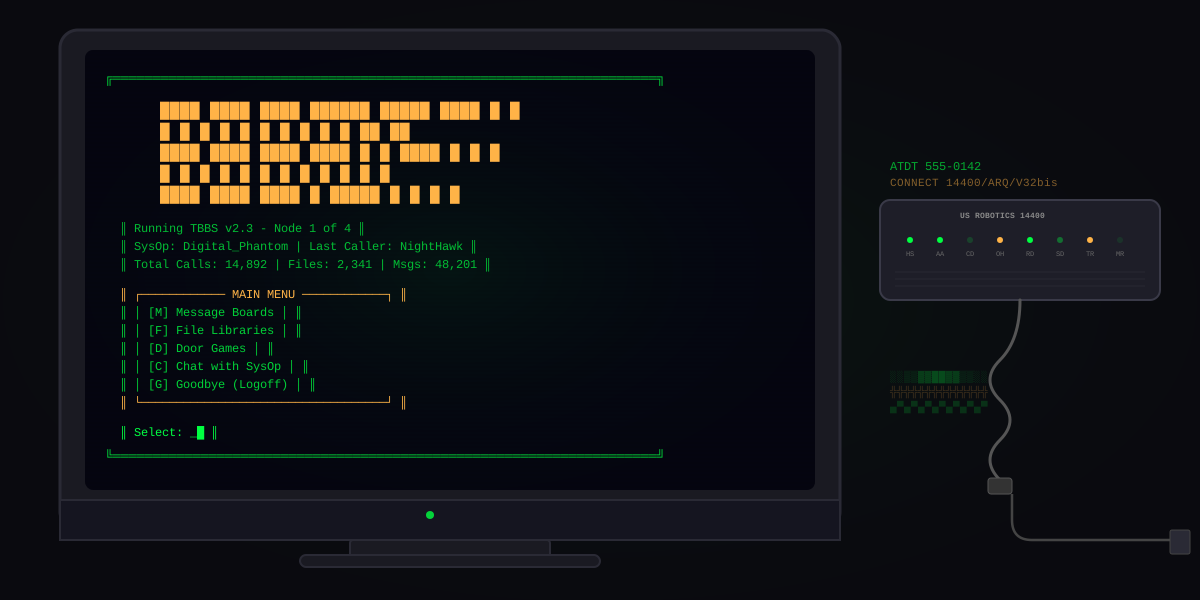
It is 2:30 AM on a Tuesday in 1993. You are sitting in a dark basement in suburban Ohio, bathed in the amber glow of a 14-inch VGA monitor. The only sounds are the hum of a 486DX2 tower, the occasional click of your keyboard, and the soft whir of a hard drive that holds your entire digital universe: 420 megabytes of files, messages, and door games. Upstairs, your family sleeps. Down here, you are a SysOp. You are the god of a small world. And right now, at this very moment, someone in the next area code is dialing your phone number, waiting for your modem to answer, waiting to enter your world.
The modem picks up. You hear the carrier tone, then the handshake: a burst of static, a series of rising and falling tones, and then silence. A new line appears on your screen: CONNECT 14400. Someone is in. You watch their keystrokes appear in real time on your SysOp console as they navigate your menus, check their messages, and fire up a round of Legend of the Red Dragon before bed. You don't know their real name. You know their handle. And in this world, that is all that matters.
This is the story of the Bulletin Board System, the BBS, the thing that came before the internet as most people know it. Before the World Wide Web, before AOL, before Netscape Navigator and Yahoo and Google, there were tens of thousands of these small, independent computer systems scattered across the country, each one running on a single phone line, each one a tiny island of community in a vast analog ocean. They were run by hobbyists, teenagers, and obsessives who spent their own money and their own time to build something that nobody asked for and everybody needed.
This is a love letter to that era. To the sound of a modem handshake. To the glow of ANSI art on a dark screen. To the SysOps who kept the lights on and the callers who kept coming back. To a time when going online meant picking up the phone, dialing a number, and entering a world that someone had built just for you.
1. Born in a Blizzard
The story of the BBS begins, appropriately enough, with a disaster. In late January 1978, a massive blizzard hit Chicago. The Great Blizzard of 1978 dumped over 20 inches of snow on the city in a single storm, shutting down roads, closing businesses, and trapping people in their homes for days. Among those snowed in were two members of the Chicago Area Computer Hobbyists' Exchange (CACHE): Ward Christensen and Randy Suess.
Christensen was a programmer at IBM. Suess was a hardware tinkerer. They had been kicking around an idea for months: what if you could create a computerized version of the cork bulletin board that hung on the wall at their club meetings? A place where members could post messages, leave notices, and share information, all accessible by phone? The blizzard gave them the time to actually build it.
Over the next few weeks, while Chicago dug itself out of the snow, Christensen wrote the software and Suess built the hardware. The system ran on an S-100 bus computer with an Intel 8080 processor, 64 kilobytes of RAM, and two 8-inch floppy disk drives. The modem was a Hayes 300 baud unit, meaning it could transfer data at roughly 30 characters per second. The software was written in 8080 assembly language. They called it CBBS, the Computerized Bulletin Board System.
On February 16, 1978, CBBS went online. It was, by any reasonable definition, the first BBS. Users could dial in, read messages left by other callers, and post their own. It was simple. It was slow. It was revolutionary. The concept of a computer that answered the phone and let strangers interact with it, leaving messages for each other asynchronously, was genuinely new. Nothing like it had existed before.
Christensen and Suess published an article about CBBS in the November 1978 issue of Byte magazine, and the idea spread like wildfire through the hobbyist computing community. Within months, other BBSes began appearing across the country. By the early 1980s, there were hundreds. By the late 1980s, thousands. The genie was out of the bottle.
What made the BBS concept so powerful was its accessibility. You didn't need a mainframe. You didn't need a university account. You didn't need permission from anyone. All you needed was a personal computer, a modem, a phone line, and some software. The barrier to entry was low enough that a teenager with a part-time job could run one. And many did.
The early BBSes were crude by later standards. Most were single-line systems, meaning only one person could be connected at a time. If you called and the line was busy, you got a busy signal and had to try again later. The software was often homegrown, written in BASIC or assembly language by the SysOp themselves. There were no standards, no protocols, no conventions. Every BBS was its own little experiment in what online communication could be.
But even in those early days, the essential elements of online community were already present. People adopted handles, pseudonyms that became their online identities. They formed friendships with people they had never met in person. They argued about politics and technology and music. They shared files, traded software, and helped each other solve problems. The BBS was, in miniature, everything the internet would eventually become. It just ran on a single phone line at 300 baud.
2. How BBSes Worked
To understand the BBS experience, you have to understand the ritual. Calling a BBS was not like opening a web browser. It was a deliberate, physical act that involved real hardware making real sounds over a real telephone line. It was, in its own way, intimate.
First, you needed a modem. The word is a portmanteau of "modulator-demodulator," and the device did exactly what the name implies: it converted digital data from your computer into analog audio signals that could travel over a phone line, and converted incoming audio signals back into digital data. Early modems ran at 300 baud, roughly 30 characters per second. By the mid-1980s, 2400 baud was common. The late 1980s brought 9600 baud. The early 1990s saw 14,400 baud (14.4k). And by the mid-1990s, the 28,800 and 33,600 baud modems arrived, eventually culminating in the legendary 56k modem that would carry the internet into the mainstream.
Each speed increase was a revelation. At 300 baud, text scrolled onto your screen slowly enough that you could read it as it appeared, character by character. At 2400 baud, text flowed smoothly but graphics were still painfully slow. At 14.4k, ANSI art screens loaded in seconds instead of minutes. At 28.8k, you could download a 1-megabyte file in about five minutes instead of an hour. Speed mattered. Speed was everything.
Next, you needed terminal software. On DOS, the gold standard was Telix, followed by Qmodem and ProComm Plus. On Windows, HyperTerminal came bundled with the operating system, though serious BBS callers used dedicated programs. Terminal software handled the modem commands, managed your phone book of BBS numbers, and emulated the terminal types that BBSes expected.
And then there was the dialing. You would open your terminal program, select a BBS from your phone book (or type in a number you'd found in a BBS list), and hit "dial." Your modem would go off-hook, seize the phone line, and begin dialing. You'd hear the touch-tones through your computer's speaker, then the ringing, and then, if you were lucky, the answer.
The modem handshake was the signature sound of the era. When the remote modem answered, the two modems would begin negotiating a connection. This produced a symphony of electronic sounds: a carrier tone, a series of warbling frequencies, bursts of static, and then silence. The entire handshake took anywhere from five to thirty seconds, depending on the modem speeds and line quality. When it was done, your terminal would display the magic word: CONNECT, followed by the negotiated speed. CONNECT 2400. CONNECT 14400. CONNECT 28800. That word meant you were in.
Once connected, you were greeted by the BBS's login screen, usually a piece of ANSI art displaying the board's name, the SysOp's handle, and a prompt for your username and password. New users went through a registration process, providing a handle, a password, and sometimes their real name and phone number (for verification). Then you were in.
The BBS interface was entirely text-based, navigated through menus. A typical main menu might look something like this: [M]essage bases, [F]ile areas, [D]oor games, [B]ulletins, [C]hat with SysOp, [G]oodbye. You pressed a single key to select an option. There was no mouse. There was no graphical interface. There was just text, sometimes enhanced with ANSI escape codes that added color, cursor positioning, and crude graphics using the extended ASCII character set of IBM Code Page 437.
ANSI escape codes were the visual language of the BBS world. They allowed BBS software to send special character sequences that the caller's terminal would interpret as commands: change the text color to bright cyan, move the cursor to row 10 column 5, clear the screen, draw a box using line-drawing characters. A skilled ANSI artist could create stunning visual displays using nothing but the 256 characters of Code Page 437 and 16 colors. These screens were used for everything: login screens, menu headers, file area banners, and goodbye screens. They were the graphic design of the BBS era, and they were beautiful.
The message bases were the heart of most BBSes. They functioned like forums: organized by topic, with threads of messages that users could read and reply to. Some BBSes had dozens of message areas covering everything from local events to programming to politics to music. Messages were stored locally on the BBS's hard drive, and if the BBS was part of a network like FidoNet, messages in networked areas would be exchanged with other BBSes overnight.
The file areas were the other major draw. BBSes hosted collections of downloadable files: shareware programs, game demos, utilities, text files, and (often) pirated software. Uploading files to a BBS was encouraged and often rewarded with extra download credits or extended time online. The file transfer protocols of the era, XMODEM, YMODEM, and ZMODEM, handled the actual data transfer, with ZMODEM being the gold standard thanks to its ability to resume interrupted downloads.
3. The Software
Running a BBS required BBS software, and the choice of software was one of the most important decisions a SysOp could make. It determined everything: what your board looked like, what features it offered, how many callers it could handle, and what kind of community it attracted. The BBS software landscape was rich, competitive, and deeply tribal. SysOps were loyal to their platform the way people today are loyal to their operating system or their text editor.
WWIV (World War IV BBS) was one of the most popular packages, especially among younger SysOps. Written by Wayne Bell starting in 1984, WWIV was distributed as shareware and ran on DOS. It was relatively easy to set up, had a clean interface, and supported a built-in network called WWIVnet that allowed WWIV boards to exchange messages. WWIV's source code was eventually released, and a passionate community of modders extended it in every direction imaginable. If you ran a WWIV board, you were part of a specific subculture within the BBS world, with its own conventions, its own network, and its own drama.
Renegade was the rebel's choice. A fork of Telegard (which was itself inspired by WWIV), Renegade was free, powerful, and endlessly customizable. It supported ANSI graphics, multiple message networks, file areas, door games, and a scripting language that let SysOps build custom menus and features. Renegade boards tended to attract a younger, more technically adventurous crowd. The software had a reputation for being slightly rough around the edges but incredibly flexible.
Telegard deserves mention as the ancestor of several popular BBS packages. Originally written by Martin Pollard as a WWIV clone, Telegard took on a life of its own and spawned multiple forks, including Renegade and Oblivion/2. It was one of the first BBS packages to support multiple message networks simultaneously, making it popular with SysOps who wanted to carry both FidoNet and other networks.
PCBoard was the professional's choice. Developed by Clark Development Company, PCBoard was commercial software, not shareware, and it showed. It was fast, stable, and feature-rich. PCBoard supported multiple phone lines (nodes), which meant a single BBS could have several callers connected simultaneously. This was a big deal. Most BBS software was single-line only, but PCBoard could handle 256 nodes. Large BBSes with multiple phone lines almost always ran PCBoard. It was the enterprise solution of the BBS world.
Wildcat! was PCBoard's main commercial competitor. Developed by Mustang Software, Wildcat! was known for its polished interface and ease of use. It was particularly popular with BBSes that catered to less technical users, thanks to its clean menus and intuitive navigation. Wildcat! also made the transition to the internet era better than most, eventually supporting telnet and web-based access.
RemoteAccess was hugely popular in Europe and among FidoNet SysOps. Written by Andrew Milner, RemoteAccess was a front-end that worked with a separate mailer program (typically FrontDoor or InterMail) to handle FidoNet mail. It was fast, lightweight, and had excellent support for ANSI graphics. Many of the most visually stunning BBSes of the early 1990s ran RemoteAccess.
Synchronet was ahead of its time. Written by Rob Swindell starting in 1991, Synchronet was a multinode BBS package that ran on DOS and later OS/2 and Windows. What made Synchronet special was its forward-thinking design: it supported multiple simultaneous callers, had a built-in JavaScript scripting engine (added later), and eventually made the transition to TCP/IP, allowing callers to connect via telnet instead of modem. Synchronet is still actively developed today, making it one of the longest-lived BBS software packages in history.
Maximus was the choice for OS/2 enthusiasts. Written by Scott Dudley, Maximus was tightly integrated with the OS/2 operating system and the Squish message base format. It was popular in the FidoNet community and known for its reliability and clean code. Maximus boards had a distinctive feel, with a no-nonsense interface that prioritized function over flash.
4. The Culture
The BBS was not just a technology. It was a culture, a community, a way of life. And at the center of every BBS was the SysOp, the System Operator, the person who owned the hardware, paid for the phone line, maintained the software, and set the rules. The SysOp was judge, jury, janitor, and host. They were the god of their small world, and they took the role seriously.
Running a BBS was not cheap. The computer itself was the biggest expense, but it was a sunk cost for most hobbyists who already owned one. The real ongoing expense was the phone line. A dedicated phone line for a BBS cost $20 to $40 per month, depending on your local phone company. That was a significant amount of money in the 1980s and early 1990s, especially for the teenagers and young adults who ran many boards. Some SysOps ran their BBS on the family phone line, which meant the board was only available at night when nobody needed the phone. Others convinced their parents to spring for a second line. The truly dedicated got their own apartment just so they could have multiple phone lines without family interference.
Multi-line BBSes were the elite tier. Each additional phone line meant another $20 to $40 per month, plus the cost of additional modems and serial ports. A four-line BBS could easily cost $150 per month in phone bills alone. Some SysOps charged membership fees to offset costs, typically $20 to $50 per year for "validated" access that granted longer time limits and access to premium file areas. Others ran their boards purely as a labor of love, absorbing the costs themselves.
The callers were the lifeblood of any BBS. A board without callers was just a computer sitting in a room, answering a phone that never rang. SysOps worked hard to attract and retain callers. They posted their BBS numbers on other boards, in local computer club newsletters, and in printed BBS lists that circulated through the community. They kept their file areas stocked with the latest shareware. They maintained active message bases. They ran popular door games. They created elaborate ANSI art screens. They did everything they could to make their board the one that people wanted to call.
The social dynamics of a BBS were unique. Because most boards were local, limited to callers within the same area code (long-distance calls were expensive and most people avoided them), the community was inherently geographic. You were talking to people who lived in your city, your suburb, your neighborhood. BBS friendships often crossed over into real life. BBS meets, also called "get-togethers" or "GTs," were common events where callers and SysOps would meet in person at a restaurant, a park, or someone's house. These were often the first time people put faces to the handles they had been reading on screen for months or years.
The handle was everything. Your handle was your identity, your reputation, your brand. Choosing a handle was a serious decision. Good handles were memorable, distinctive, and slightly mysterious. They ranged from the straightforward (The Professor, Night Owl) to the dramatic (Dark Phoenix, Crimson Ghost) to the absurd (Captain Crunch, The Jolly Roger). Once you established a handle, you were known by it across every BBS you called. Your handle preceded you. People knew your handle before they knew your name, and many BBS friendships existed for years before real names were ever exchanged.
The SysOp had absolute power over their board. They could read private messages (and many did). They could delete accounts. They could ban callers. They could modify the rules at any time. There was no appeals process, no terms of service, no corporate oversight. If the SysOp didn't like you, you were gone. This created a dynamic that was simultaneously authoritarian and deeply personal. A good SysOp was a benevolent dictator who fostered community, mediated disputes, and kept the board running smoothly. A bad SysOp was a petty tyrant who played favorites, read private mail, and banned anyone who disagreed with them. Most SysOps fell somewhere in between.
5. Door Games
If message bases were the heart of a BBS, door games were its soul. "Doors" were external programs that BBS software could launch for a connected caller, passing the connection through to the external program and then resuming control when the program exited. The name came from the metaphor of opening a door to leave the BBS and enter another program. In practice, doors were used for all sorts of things, but the most popular doors by far were games.
BBS door games were the first online multiplayer games. Not in the sense of real-time multiplayer, where players interact simultaneously (though a few doors on multi-line BBSes did support that). Rather, they were asynchronous multiplayer: you played your turn, and the game saved your state. The next caller played their turn against the same game world. Over the course of a day, dozens of players would each take their turns, and the game world evolved through their collective actions. It was turn-based multiplayer gaming, and it was addictive beyond reason.
Legend of the Red Dragon (LORD) was the undisputed king of door games. Written by Seth Able Robinson and released in 1989, LORD was a text-based RPG set in a fantasy world where players fought monsters, gained experience, leveled up, and eventually challenged the Red Dragon itself. But LORD's genius wasn't in its combat system or its fantasy setting. It was in its social features. Players could flirt with each other at the inn. They could attack other players in player-vs-player combat. They could write messages on the town bulletin board. They could get married. LORD turned a simple RPG into a social simulation, and the drama that unfolded on BBS after BBS was legendary. Alliances formed. Rivalries burned. Romances bloomed. All in a text-based game running on a 486 in someone's closet.
TradeWars 2002 was LORD's equal in popularity but completely different in style. Originally written by Chris Sherrick and later developed by Gary Martin and John Pritchett, TradeWars was a space trading and combat game. Players piloted ships through a galaxy of sectors, trading commodities between ports, building space stations, forming corporations with other players, and engaging in ship-to-ship combat. TradeWars was deeper and more strategic than LORD, with a complexity that rewarded long-term planning and political maneuvering. The best TradeWars players were master strategists who could manipulate markets, coordinate attacks with allies, and control entire regions of the galaxy. Games could run for weeks or months, with the political landscape shifting daily.
Barren Realms Elite (BRE) and Solar Realms Elite (SRE) were empire-building games that took the concept even further. In BRE, players managed medieval kingdoms, building armies, developing economies, and waging war against other players. SRE was the same concept in a science fiction setting. Both games supported inter-BBS play through networks like FidoNet, meaning your kingdom could be attacked by a player on a completely different BBS in a different city. This was mind-blowing in 1993. You were playing a strategy game against opponents you had never met, on computers you had never seen, connected through a network of phone lines that spanned the country.
Usurper was the dark horse of door games. A Dutch-made RPG that combined elements of LORD with a more complex combat system and a darker tone, Usurper had a devoted following among players who found LORD too simple. It featured multiple character classes, a detailed equipment system, and a reputation mechanic that tracked whether your character was good or evil. Usurper never achieved LORD's mainstream popularity, but among door game enthusiasts, it was considered the more sophisticated game.
Other notable door games included Operation: Overkill, a post-apocalyptic RPG; Planets: The Exploration of Space (TEOS), another space trading game; Food Fight, a silly but addictive action game; and Global War, a Risk-like strategy game. There were hundreds of door games available, covering every genre from trivia to gambling to text adventures. The door game ecosystem was, in retrospect, a thriving indie game scene decades before "indie games" became a recognized category.
6. FidoNet
The great limitation of the BBS was its isolation. Each board was an island, connected to the outside world only by its phone line. Messages posted on one BBS stayed on that BBS. If you wanted to have a conversation with someone on a different board, you had to call that board separately. There was no interconnection, no network, no way for BBSes to talk to each other. Until FidoNet.
FidoNet was created in 1984 by Tom Jennings, the author of the Fido BBS software. The concept was elegant in its simplicity: what if BBSes could call each other automatically, late at night when phone rates were cheapest, and exchange messages? Each BBS would collect outgoing messages during the day, then during a designated window (typically 2:00 AM to 4:00 AM local time, known as "Zone Mail Hour" or "ZMH"), the BBS would dial other BBSes and exchange message packets. The next morning, callers would find new messages from people on other boards, sometimes in other cities or even other countries.
This was store-and-forward networking, and it was brilliant. It didn't require any special hardware or dedicated connections. It used the same phone lines and modems that BBSes already had. The only cost was the long-distance phone calls, and by routing messages through intermediate nodes, the network could minimize long-distance charges. A message from New York to Los Angeles didn't have to travel in a single expensive long-distance call. It could hop from node to node, traveling through local and regional connections, reaching its destination in a day or two.
FidoNet used a hierarchical addressing system: Zone:Region/Network/Node. Zone 1 was North America, Zone 2 was Europe, Zone 3 was Oceania, and so on. Within each zone, regions and networks organized BBSes geographically. A typical FidoNet address looked like 1:123/456, meaning Zone 1, Network 123, Node 456. The system was administered by volunteer coordinators at each level of the hierarchy, from local network coordinators up to zone coordinators.
The two main types of FidoNet communication were netmail and echomail. Netmail was private, point-to-point messaging, the equivalent of email. You addressed a message to a specific FidoNet address, and the network routed it to the destination. Echomail was the public discussion system, equivalent to Usenet newsgroups or modern forums. Echomail conferences (or "echoes") were topic-based discussion areas that were distributed across all participating BBSes. When you posted a message in an echomail conference, it would propagate across the network over the next day or two, appearing on every BBS that carried that conference.
At its peak in the mid-1990s, FidoNet had over 30,000 nodes worldwide, spanning six continents. It carried thousands of echomail conferences on every topic imaginable. It was, in effect, a global discussion network built entirely on volunteer labor and phone lines. No corporation ran it. No government funded it. It was pure grassroots networking, built by hobbyists for hobbyists.
The technical infrastructure of FidoNet was a marvel of pragmatic engineering. Message packets were compressed and bundled for efficient transfer. Routing tables were maintained and distributed by coordinators. Software like FrontDoor, InterMail, and BinkleyTerm handled the automated calling and packet exchange. The entire system ran on trust and cooperation. If a node went down, messages would queue up and be delivered when it came back online. If a coordinator disappeared, the community would find a replacement. It was resilient in the way that only decentralized, volunteer-run systems can be.
FidoNet also had its share of drama. The network was governed by a document called Policy 4, which laid out the rules for participation and the responsibilities of coordinators. Disputes over Policy 4 interpretations, coordinator elections, and network governance were legendary in their intensity. The FidoNet community could argue about routing topology with the same passion that people today argue about programming languages. It was, in every sense, a precursor to the governance debates that would later consume open-source communities and internet standards bodies.
7. The Warez Scene
No history of the BBS era would be complete without addressing the elephant in the room: warez. The word, a corruption of "wares" (as in "software"), referred to pirated software distributed through BBSes. The warez scene was the dark underbelly of the BBS world, a parallel universe of release groups, couriers, elite boards, and a culture of competition that treated software piracy as a sport.
The warez scene had its own hierarchy, its own rules, and its own honor code. At the top were the release groups, crews of crackers who obtained commercial software, removed the copy protection, and packaged it for distribution. The most legendary groups read like a hall of fame of the digital underground: The Humble Guys (THG), one of the earliest and most prolific groups; Fairlight, a Swedish group that dominated the European scene; RAZOR 1911, perhaps the most famous release group of all time, active since 1985 and still technically in existence; Pirates with Attitudes (PWA); Drink or Die (DOD); and dozens of others.
Each release group competed to be the first to crack and distribute a new piece of software. This was the concept of 0-day (zero-day): releasing a cracked version of software on the same day it was officially released, or sometimes even before. Being first was everything. Groups would race to obtain advance copies of software, crack the protection, and get the release onto the top BBSes before anyone else. The competition was fierce, and the bragging rights were the only reward. Nobody was making money from this. It was pure ego, pure competition, pure sport.
Every release came with an NFO file (short for "info"), a text file that served as the group's calling card. NFO files were works of art in themselves, featuring elaborate ASCII and ANSI art logos, the group's member list, greetings to allied groups, and information about the release. The NFO file was the group's brand, and groups took enormous pride in their NFO art. A well-designed NFO file was a status symbol, a declaration of identity and skill.
Below the release groups were the couriers, the people who moved warez from board to board. Couriers were the distribution network of the scene. When a group released a new crack, couriers would download it from the group's home BBS and upload it to other boards as fast as possible. Speed was everything. The fastest couriers had access to multiple phone lines and could transfer files to dozens of boards in a single night. Courier groups competed for rankings on "topsite" charts that tracked who distributed the most releases the fastest.
The BBSes that hosted warez were called elite boards or simply "sites." Access to the best sites was restricted and invitation-only. You had to prove yourself as a courier, a cracker, or an ANSI artist to get an account. These boards often ran on dedicated hardware with multiple phone lines and large hard drives (by the standards of the time). Some had 10 or 20 gigabytes of storage, which was an enormous amount in the early 1990s. The SysOps of elite boards were respected figures in the scene, and their boards were the hubs around which the entire distribution network revolved.
The warez scene existed in a legal gray area that was, in reality, not gray at all. Software piracy was illegal, and everyone involved knew it. But enforcement was rare in the BBS era. The software industry focused its anti-piracy efforts on commercial-scale counterfeiters, not on teenagers trading cracked games over phone lines. This changed in the mid-1990s as the scene moved to the internet and the scale of piracy exploded. Operations like the FBI's Operation Buccaneer in 2001 and Operation Fastlink in 2004 eventually brought serious legal consequences to scene members. But in the BBS era, the warez scene operated with relative impunity, a shadow economy running on phone lines and floppy disks.
8. ANSI Art
If the BBS was a building, ANSI art was its architecture. Every BBS worth calling had custom ANSI art screens: a login screen that announced the board's name and personality, menu headers that guided callers through the system, file area banners, goodbye screens, and decorative elements scattered throughout. ANSI art was the visual identity of the BBS, and the quality of a board's art said everything about the SysOp's taste and connections.
ANSI art was created using ANSI escape codes, a set of special character sequences that controlled the appearance of text on a terminal. These codes could change text and background colors (from a palette of 16 colors), move the cursor to any position on the screen, and display any of the 256 characters in IBM Code Page 437. Code Page 437 was the character set built into IBM PCs and compatibles, and it included not just letters and numbers but a rich set of line-drawing characters, block elements, mathematical symbols, and other graphical characters that ANSI artists used as their building blocks.
The primary tool for creating ANSI art was TheDraw, written by Ian Davis and released in 1986. TheDraw was a DOS-based ANSI editor that let artists place characters and colors on a grid, essentially painting with text. It was simple, intuitive, and powerful enough to create stunning work. TheDraw was to ANSI art what Photoshop would later be to digital photography: the defining tool of the medium. Other editors existed, including ACiDDraw (created by the ACiD art group) and PabloDraw (a later, more modern editor), but TheDraw was the original and the most widely used.
The ANSI art scene coalesced around art groups, collectives of artists who released monthly artpacks containing their latest work. The two most famous groups were ACiD Productions (ANSI Creators in Demand) and iCE (Insane Creators Enterprise). ACiD was founded in 1990 and quickly became the most prestigious art group in the scene. Getting accepted into ACiD was like getting into an elite university: you had to submit a portfolio, and only the best were admitted. iCE was ACiD's great rival, and the competition between the two groups pushed the art form to extraordinary heights.
Other notable art groups included Blade, Fire, Remorse, Dark, and dozens of others. Each group had its own style and personality. Some specialized in large, detailed pieces that filled multiple screens. Others focused on small, precise logos and headers. Some pushed the boundaries of what was possible with 16 colors and 80 columns. The artpack releases were events in themselves, eagerly anticipated and widely discussed.
The artpacks were distributed through BBSes and later through FTP sites. Each pack was a ZIP archive containing the group's latest ANSI and ASCII art, along with an NFO file and sometimes music files (MOD tracker modules that could be played while viewing the art). The packs were organized with a viewer program that let you browse the art with proper ANSI rendering. Monthly artpack releases were the heartbeat of the scene, and the quality of work produced was genuinely remarkable.
ANSI art was constrained in ways that made it uniquely challenging. You had exactly 16 colors (8 normal, 8 bright). Your canvas was 80 columns wide. Your "pixels" were text characters, each occupying a fixed-width cell. You couldn't do gradients, transparency, or anti-aliasing. And yet, within these constraints, artists created portraits, landscapes, logos, and abstract compositions that were breathtaking in their skill and creativity. The best ANSI art transcended its medium, turning the limitations of a text terminal into an aesthetic that was beautiful precisely because of its constraints.
The legacy of the ANSI art scene is preserved today at 16colo.rs, an online archive that hosts thousands of artpacks from the 1990s and beyond. Browsing the archive is like walking through a museum of a lost art form. The work ranges from crude early experiments to masterpieces that rival anything produced in more conventional digital media. The ANSI art scene also continues to this day, with active artists still creating new work and new artpacks being released regularly.
9. Phone Phreaking
The BBS world and the phone phreaking world were deeply intertwined. This was inevitable: BBSes ran on phone lines, and phone calls cost money. The desire to call BBSes outside your local area code without paying long-distance charges was a powerful motivator, and phone phreaking, the art of exploiting the telephone network, provided the means.
Phone phreaking predated the BBS by over a decade. Its origins trace back to the 1960s, when a blind teenager named Joe Engressia (later known as Joybubbles) discovered that he could whistle a perfect 2600 Hz tone, the exact frequency that AT&T's long-distance switching equipment used as a control signal. By whistling this tone into a phone handset, he could trick the network into giving him free long-distance calls. This discovery, and the subculture that grew around it, became known as phone phreaking.
The most famous phreaking tool was the blue box, an electronic device that generated the multi-frequency tones used by AT&T's signaling system. A blue box could seize a trunk line and dial any number in the world for free. The blue box was famously built and used by John Draper (Captain Crunch), who discovered that a toy whistle included in boxes of Cap'n Crunch cereal produced a perfect 2600 Hz tone. Draper became a legend of the phreaking world, and his handle became one of the most famous in hacker history.
Perhaps the most consequential blue box story involves two young men in California: Steve Wozniak and Steve Jobs. In the early 1970s, before Apple Computer existed, Wozniak built blue boxes and Jobs sold them to Berkeley students for $150 each. Wozniak has said that without the blue box experience, there would have been no Apple Computer. The blue box taught them that two guys in a garage could build a device that controlled a billion-dollar telephone network. That lesson, that individuals could challenge institutions through technology, became the founding philosophy of Apple and, arguably, of Silicon Valley itself.
The red box was the phreaker's tool for pay phones. It generated the tones that pay phones sent to the network to indicate that coins had been deposited. A quarter produced a specific dual-tone signal, and a red box could reproduce that signal, tricking the pay phone into thinking money had been inserted. Red boxes were often built from modified Radio Shack tone dialers, with a crystal oscillator swapped to produce the correct frequencies. They were simple to build, widely documented in phreaking text files distributed on BBSes, and enormously popular among teenagers who wanted to make free calls from pay phones.
The connection between phreaking and BBSes was direct and practical. Long-distance calls were expensive, and the best BBSes were often in other area codes. Phreaking provided free long-distance access, which meant access to more boards, more files, more door games, and more communities. Many BBS callers dabbled in phreaking out of simple economic necessity. The text files that explained phreaking techniques were among the most popular downloads on BBSes, and dedicated phreaking BBSes served as hubs for the community.
The phreaking community also contributed to BBS culture in more abstract ways. The hacker ethic, the belief that information should be free, that systems should be explored and understood, that authority should be questioned, was deeply rooted in the phreaking tradition. The magazine 2600: The Hacker Quarterly, named after the famous 2600 Hz tone, was a bridge between the phreaking world and the broader hacker community. Many of the attitudes and values that would later define internet culture, the suspicion of corporate control, the celebration of technical cleverness, the belief in the democratizing power of technology, were forged in the phreaking and BBS communities of the 1970s and 1980s.
By the mid-1990s, the phone network had largely transitioned from analog signaling to digital, rendering most phreaking techniques obsolete. Blue boxes stopped working. Red boxes became unreliable as pay phones were upgraded. The phreaking era faded, but its cultural legacy lived on in the hacker communities that grew out of it, communities that found their first home on BBSes.
10. The Decline
The BBS era peaked in 1994. By most estimates, there were approximately 60,000 BBSes operating in North America that year, serving an estimated 17 million users. Boardwatch Magazine, the trade publication of the BBS industry, published thick monthly issues filled with BBS listings, software reviews, and advertisements for multi-line hardware. The BBS was a mature technology with a thriving ecosystem. And it was about to be destroyed.
The killer was the World Wide Web. The web had existed in some form since Tim Berners-Lee created it at CERN in 1991, but it didn't reach mainstream awareness until 1993, when the Mosaic web browser made it accessible to ordinary users. Mosaic, and its successor Netscape Navigator (released in December 1994), showed people what the internet could look like: graphical, colorful, point-and-click, with images and hyperlinks and a seemingly infinite amount of content. Compared to the text-based, menu-driven, one-call-at-a-time world of the BBS, the web was a revelation.
The transition happened with stunning speed. In 1994, most home computer users had never seen a web browser. By 1996, the web was everywhere. Internet Service Providers like AOL, CompuServe, and Prodigy, which had previously offered their own proprietary online services, pivoted to providing web access. New ISPs sprang up in every city, offering dial-up internet access for $19.95 per month. For that flat monthly fee, you got unlimited access to the entire internet: email, the web, Usenet newsgroups, FTP, IRC, and everything else. Why would you call a single BBS on a single phone line when you could access the entire world?
The BBS community tried to adapt. Many SysOps added telnet access to their boards, allowing internet users to connect without a modem call. Some added web interfaces. BBS software developers scrambled to add internet features. But it was too little, too late. The fundamental architecture of the BBS, a single computer answering phone calls, was obsolete in a world of always-on internet connections and graphical web browsers.
The commercial BBS software companies were hit hardest. Clark Development Company, the maker of PCBoard, shut down in 1997. Mustang Software, the maker of Wildcat!, was acquired by Platinum Technology in 1997 and the product was eventually discontinued. eSoft, the maker of TBBS, pivoted to internet appliances. The commercial BBS software market, which had been a real industry with real revenue, evaporated in less than three years.
The decline was not uniform. Some BBSes hung on for years, serving loyal communities that preferred the BBS experience to the chaos of the early web. FidoNet continued to operate, though its node count dropped steadily. Door games continued to be played on the boards that remained. But the trend was unmistakable. By 1998, the BBS era was effectively over. The phone lines went silent. The modems were unplugged. The 486s and Pentiums that had served as BBS hosts were repurposed or recycled. An entire ecosystem, built over two decades by thousands of volunteers, dissolved in the space of a few years.
The speed of the collapse was, in retrospect, a testament to how much better the web was at doing what BBSes did. The web offered everything a BBS offered, forums, file downloads, games, community, but without the limitations of a single phone line, a local area code, and a text-based interface. The BBS didn't die because it was bad. It died because something better came along. That is the way of technology, and it is both inevitable and a little bit sad.
11. Still Alive
But the BBS is not dead. Not entirely. Like a species that survives a mass extinction by adapting to a new niche, the BBS has persisted into the 21st century, transformed but recognizable. A small but passionate community of SysOps and callers keeps the tradition alive, running modern BBS software on modern hardware, accessible via telnet and SSH instead of modem calls.
Synchronet, the BBS software written by Rob Swindell in 1991, is still actively developed and maintained. It runs on modern operating systems (Windows, Linux, macOS) and supports telnet, SSH, and web-based access. Synchronet boards are fully functional BBSes with message bases, file areas, door games, and all the features of a classic board, just accessible over the internet instead of a phone line. The Synchronet community is active and welcoming, and new boards are still being set up.
Mystic BBS is another actively developed BBS package, written by James Coyle. Mystic is known for its excellent ANSI support and its faithful recreation of the classic BBS experience. It runs on Windows, Linux, macOS, and even Raspberry Pi, making it possible to run a BBS on a $35 single-board computer. Mystic has a devoted following among retro computing enthusiasts and ANSI art fans.
The Telnet BBS Guide (telnetbbsguide.com) maintains a directory of active BBSes accessible via telnet. As of 2026, the directory lists several hundred active boards worldwide. Some are nostalgic recreations of classic BBSes. Others are new boards run by people who discovered the BBS concept through retro computing communities. A few are original boards that have been running continuously since the 1990s, having transitioned from dial-up to telnet without ever going offline.
ISCABBS (Iowa Student Computer Association BBS) deserves special mention as one of the longest-running BBSes in history. Originally established at the University of Iowa in 1989, ISCABBS has been running continuously for over 35 years. It transitioned from dial-up to telnet in the 1990s and continues to operate today, with an active community of users who have been posting messages and chatting for decades. ISCABBS is a living artifact, a direct connection to the BBS era that has never been interrupted.
The retro computing movement has also brought renewed interest in BBSes. Enthusiasts who collect and restore vintage hardware often set up BBSes as a way to use their old computers for their original purpose. There is something deeply satisfying about connecting to a BBS running on actual 1990s hardware, hearing the modem handshake (if you have a modem), and navigating menus that look exactly as they did thirty years ago. It is computing as archaeology, a way of experiencing the past not through reading about it but through doing it.
Modern BBS communities tend to attract a specific type of person: someone who values the slower pace of asynchronous communication, who appreciates the aesthetic of text-based interfaces, who finds something appealing about the intimacy of a small community. In an age of algorithmic feeds, infinite scroll, and attention-harvesting social media, the BBS offers something radically different: a quiet room where people talk to each other, one message at a time, without likes or shares or engagement metrics. For some people, that is exactly what they need.
12. Cultural Impact
The BBS era lasted roughly two decades, from 1978 to the late 1990s. In that time, it created or incubated nearly every concept that defines online life today. The BBS didn't just precede the internet as we know it. It invented the internet as we know it, in miniature, on phone lines, one caller at a time.
Online community. The BBS was the first place where ordinary people experienced online community. Not researchers at universities. Not military personnel on ARPANET. Regular people, in their homes, connecting with strangers who shared their interests. The social dynamics of BBS communities, the friendships, the feuds, the drama, the inside jokes, the sense of belonging to something, are identical to the dynamics of every online community that followed. Facebook groups, Reddit communities, Discord servers: they are all descendants of the BBS message base.
The hacker ethic. The BBS was where the hacker ethic was transmitted from the academic and phreaking communities to the general public. The belief that information wants to be free, that systems should be explored and understood, that technical skill confers a kind of moral authority, these ideas were debated and refined on BBSes throughout the 1980s and 1990s. The hacker ethic, for better and worse, became the founding philosophy of internet culture, and it was BBSes that spread it.
Shareware. The shareware distribution model, where software is distributed freely with a request (or requirement) to pay if you continue using it, was born on BBSes. Programs like PKZIP, Doom, Wolfenstein 3D, and thousands of utilities were distributed as shareware through BBS file areas. The shareware model was the direct ancestor of modern free-to-play, freemium, and open-source distribution models. Without BBSes as a distribution channel, shareware could not have existed, and the entire economics of software distribution would have evolved differently.
Digital art. The ANSI art scene was one of the first digital art movements. It produced thousands of works, developed its own aesthetic language, created its own institutions (art groups, artpacks, competitions), and built a community of artists who pushed the boundaries of a severely constrained medium. The ANSI art scene was a precursor to pixel art, demoscene art, and the broader digital art world. Its influence can be seen in the retro aesthetic that pervades modern indie games, web design, and graphic design.
Online gaming. Door games were the first online multiplayer games experienced by a mass audience. The concepts they pioneered, daily engagement loops, persistent game worlds, player-vs-player competition, social features integrated into gameplay, asynchronous multiplayer, are the foundation of modern online gaming. Every mobile game that gives you a limited number of daily turns, every MMO with a persistent world, every game with a leaderboard and social features, owes a debt to LORD and TradeWars and the hundreds of other door games that ran on BBSes in the late 1980s and early 1990s.
File sharing. The BBS was the original file-sharing network. Long before Napster, LimeWire, and BitTorrent, BBSes were the primary channel for distributing software, both legitimate and pirated. The warez scene that flourished on BBSes established the culture, the infrastructure, and the techniques that would later power internet-based file sharing. The release group structure, the NFO file format, the courier networks, even the naming conventions, all originated in the BBS warez scene and persist to this day.
Decentralized networking. FidoNet demonstrated that a global communication network could be built and operated entirely by volunteers, without corporate ownership or government funding. This was a radical idea in the 1980s, and it directly influenced the development of other decentralized networks, including Usenet and, eventually, the peer-to-peer networks of the 2000s. The principle that ordinary people could build and operate their own communication infrastructure, proven by FidoNet, remains one of the most important ideas in the history of networking.
13. Notable BBSes
Tens of thousands of BBSes operated during the era, each one a unique creation of its SysOp. Most are forgotten now, remembered only by the people who called them. But a few achieved a level of fame that transcended their local communities, becoming landmarks of the BBS world.
CBBS (Chicago, Illinois, 1978) was the first. Created by Ward Christensen and Randy Suess, CBBS was the original bulletin board system, the one that started it all. It ran on an S-100 bus computer with an 8080 processor and a 300 baud modem. CBBS operated continuously for over 20 years, a remarkable achievement for a system built from hobbyist hardware in a Chicago basement. It was never the biggest or the most feature-rich BBS, but it was the first, and that distinction alone earns it a permanent place in computing history.
The WELL (Sausalito, California, 1985) was not a typical BBS, but it was one of the most influential online communities of the era. Founded by Stewart Brand (of Whole Earth Catalog fame) and Larry Brilliant, The WELL (Whole Earth 'Lectronic Link) was a dial-up conferencing system that attracted an extraordinary community of writers, thinkers, technologists, and counterculture figures. The WELL's discussions were legendary for their depth and quality. Many of the people who shaped early internet culture, including Howard Rheingold, John Perry Barlow (co-founder of the Electronic Frontier Foundation), and Kevin Kelly (founding editor of Wired magazine), were active WELL members. The WELL is still operating today as a web-based community, making it one of the oldest continuously operating online communities in the world.
Exec-PC (New Berlin, Wisconsin, 1983) was, at its peak, the largest BBS in the world. Founded by Bob Mahoney, Exec-PC grew from a single-line hobby board to a massive operation with over 300 phone lines, serving tens of thousands of callers. It hosted an enormous file library and was one of the first BBSes to offer internet access to its callers. Exec-PC was a commercial operation, charging membership fees and generating real revenue. It demonstrated that the BBS model could scale beyond a hobby, though the arrival of the web ultimately made its business model obsolete.
Rusty n Edie's (Boardman, Ohio, 1987) was another giant of the BBS world. Run by Russell and Edith Hardenburgh, Rusty n Edie's grew to over 100 phone lines and became one of the most popular BBSes in the country. It was known for its massive file library and its active chat system. Rusty n Edie's also became infamous when the Hardenburghs were raided by the FBI in 1993 for hosting pirated software, one of the first high-profile legal actions against a BBS for copyright infringement. The case highlighted the legal risks that SysOps faced and sent shockwaves through the BBS community.
Software Creations (Worcester, Massachusetts, 1988) was the premier BBS for shareware game distribution. Run by Dan Linton, Software Creations was the official distribution site for many of the biggest shareware game companies, including Apogee Software (later 3D Realms) and id Software. If you wanted the latest shareware release of Commander Keen, Wolfenstein 3D, or Doom, Software Creations was where you got it. The board was a direct pipeline from game developers to players, and it played a crucial role in the shareware gaming revolution of the early 1990s.
These are just a few of the notable boards. Every city had its own legendary BBSes, boards that were famous within their local community even if they were unknown outside it. The SysOp who ran the best door game league. The board with the fastest file downloads. The one with the most active message bases. The one where everyone hung out. These local legends are the unsung heroes of the BBS era, the people who built communities in their basements and spare bedrooms, one phone line at a time.
The Last Carrier Tone
The BBS era is over. The phone lines are silent. The modems are in landfills. The 486s that served as BBS hosts have been recycled into their component metals. The SysOps have moved on to careers in IT, in software development, in network engineering, in a hundred other fields that their BBS experience prepared them for. The callers have grown up, had families, built careers. The handles they used thirty years ago are forgotten by everyone except themselves.
But the things that were built during the BBS era, the communities, the culture, the technology, the art, the games, the networks, the ethics, those things live on. They are embedded in the DNA of the internet. Every time you post a message on a forum, you are doing what BBS callers did in 1985. Every time you download a file, you are doing what BBS callers did in 1990. Every time you play an online game with strangers, you are doing what BBS callers did in 1992. The medium has changed. The experience has not.
If you were there, if you heard the modem handshake, if you navigated ANSI menus, if you played LORD at 2 AM, if you argued about politics in a FidoNet echomail conference, if you downloaded shareware at 2400 baud, if you were a SysOp or a caller or both, then you were part of something that mattered. You were part of the first generation of online citizens, the people who figured out what it meant to live part of your life in a digital world. You did it on phone lines, with modems, one call at a time. And it was magnificent.
The carrier tone has faded. But if you listen carefully, you can still hear it.
CONNECT 14400