The Geocities Era: Neighborhoods, GIFs, and the Folk Art Web
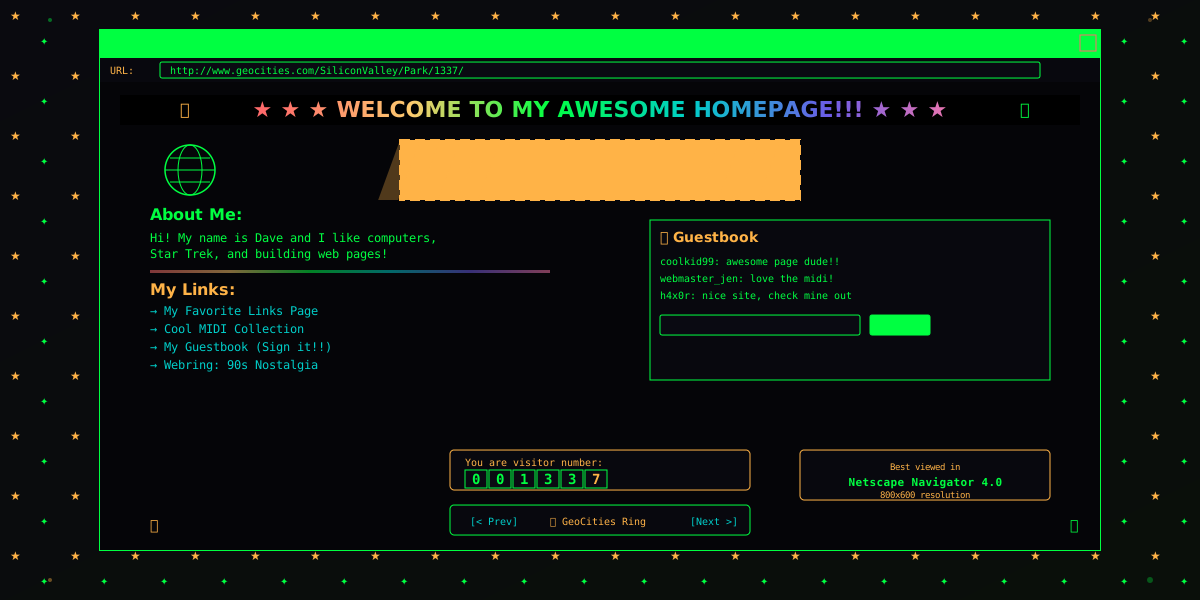
It is 1997. You are twelve years old, and you have just discovered the most powerful thing in the world. Not a weapon. Not money. Not even the internet itself, though that is part of it. You have discovered that you can make a website. You, personally. A kid in a bedroom in a suburb somewhere in middle America, with a Compaq Presario and a 28.8k modem and a copy of Netscape Navigator 3.0. You can make a page that anyone on the entire planet can see. And it will cost you nothing.
You go to a site called Geocities. You pick a neighborhood. You pick an address. And then you start building. You don't know HTML, not really, but you know enough. You know that <b> makes things bold and <font color="red"> makes things red and <marquee> makes text scroll across the screen. You know how to right-click on someone else's page and select "View Source" and copy whatever they did. You know how to find animated GIFs on clip art sites and paste them into your page. You know how to add a visitor counter and a guestbook and a link that says "Sign my guestbook!" in blinking text.
Your page is terrible. It has a tiled background of tiny stars that makes the text almost unreadable. It has three different font colors on the same line. It has an "Under Construction" GIF even though the page will never actually be finished. It autoplays a MIDI version of the X-Files theme song. The cursor leaves a trail of sparkles when you move it. There is a spinning email icon that links to your Hotmail address. There is a web ring navigation bar at the bottom. There is a hit counter that reads 00047, and at least 30 of those hits are you.
It is the most beautiful thing you have ever made.
This is the story of Geocities, the free web hosting service that gave millions of people their first taste of publishing on the World Wide Web. It is the story of how a company called Beverly Hills Internet turned into the third most visited site on the entire internet, how Yahoo bought it for $3.57 billion and then destroyed it, how volunteers raced to save what they could before the servers went dark, and how the spirit of Geocities lives on today in ways its founders never imagined.
1. Beverly Hills Internet
The story of Geocities begins in 1994, in the office of a small internet company in Beverly Hills, California. David Bohnett was a 38-year-old entrepreneur who had already been through the startup grinder once before. He had co-founded a company called Ameriquest (not the mortgage lender, a different one) and had been watching the World Wide Web explode from a curiosity into a phenomenon. The Mosaic browser had launched in 1993. Netscape was about to change everything. And Bohnett had an idea.
The idea was simple: give people free web space. In 1994, if you wanted a website, your options were limited and expensive. You could pay an ISP for hosting, which might cost $20 to $50 a month, a significant amount of money for a hobbyist. You could get space through a university if you were a student. Or you could run your own server, which required technical knowledge and a dedicated internet connection that most people didn't have. The web was growing fast, but the tools for ordinary people to participate were almost nonexistent.
Bohnett, along with co-founder John Rezner, launched Beverly Hills Internet in November 1994. The concept was straightforward: sign up, get free web space, build your page. The company would make money through advertising, banner ads placed on user pages. It was one of the earliest implementations of the ad-supported free service model that would come to define the entire internet economy.
But Bohnett added a twist that turned out to be genius. Instead of just giving people a URL like www.bhi.com/~username, he organized the hosting service into themed neighborhoods. Your web address would be something like www.geocities.com/Hollywood/1234 or www.geocities.com/Area51/5678. The neighborhood you chose reflected the content of your site. It was a metaphor that made the abstract concept of web hosting feel tangible, even physical. You weren't just getting server space. You were moving into a neighborhood. You were getting an address.
In June 1995, Beverly Hills Internet was renamed Geocities. The name was a portmanteau of "geography" and "cities," reinforcing the neighborhood metaphor. The timing was perfect. The web was entering its first great growth phase. Millions of people were getting online for the first time through AOL, CompuServe, and Prodigy. They were discovering the web through Netscape Navigator. And many of them wanted to do more than just browse. They wanted to create. Geocities gave them the easiest possible way to do that.
By the end of 1995, Geocities had tens of thousands of "homesteaders," the term the company used for its users. By 1997, it had over a million. By 1998, it was the third most visited site on the entire World Wide Web, behind only AOL and Yahoo. The growth was staggering. At its peak, Geocities was adding thousands of new pages every single day. It had become, almost by accident, the largest collection of user-generated content the world had ever seen.
2. The Neighborhoods
The neighborhood system was the soul of Geocities. It wasn't just a filing system or a URL scheme. It was a community structure, a way of organizing millions of strangers into groups that shared common interests. Each neighborhood had its own identity, its own culture, and its own volunteer leaders. It was, in retrospect, one of the most successful community design experiments in the history of the internet.
The original neighborhoods, and the ones that followed, each had a distinct personality:
Area51 was for science fiction, fantasy, and the paranormal. It was one of the most popular neighborhoods, home to fan pages for The X-Files, Star Trek, Star Wars, and every other franchise that attracted obsessive fans. Area51 pages tended to be dark, heavy on animated GIFs of aliens and UFOs, and frequently featured MIDI renditions of sci-fi theme songs. The conspiracy theory pages were legendary.
SiliconValley was for technology and computing. This was where the programmers, hardware enthusiasts, and early Linux advocates built their pages. SiliconValley sites tended to be more text-heavy and less visually chaotic than other neighborhoods, though "less chaotic" is relative when we're talking about Geocities. Many of these pages were genuinely useful, hosting tutorials, software downloads, and technical documentation that couldn't be found anywhere else.
Hollywood was for entertainment, movies, and television. Fan pages for every show and movie imaginable lived here. Episode guides, cast biographies, fan fiction, screen captures painstakingly saved as low-resolution JPEGs. If you wanted to know everything about Buffy the Vampire Slayer or The Simpsons or Friends in 1997, Hollywood was where you went.
WestHollywood deserves special mention. It was the LGBTQ+ neighborhood, one of the first major online spaces explicitly created for and by the queer community. In the mid-1990s, when being openly gay was still dangerous in much of America, WestHollywood provided a space where people could be themselves, share their stories, find resources, and connect with others. Many users have written about how their WestHollywood page was the first place they ever came out. David Bohnett, who is himself gay, created the neighborhood intentionally. It was not an afterthought. It was a statement.
Heartland was for families and community. Athens was for education and literature. CapitolHill was for politics and government. Nashville was for country music. SunsetStrip was for rock and punk. Broadway was for theater. Colosseum was for sports. EnchantedForest was for children and young people. Pentagon was for military topics. RainForest was for environmental causes. TimesSquare was for games and gaming. Tokyo was for anime and Japanese culture, years before anime went mainstream in the West.
Each neighborhood had community leaders, volunteers who helped new homesteaders get set up, enforced basic guidelines, and organized neighborhood activities. These were unpaid positions, filled by enthusiastic users who cared about their communities. The community leader system was one of the things that made Geocities feel like more than just a hosting service. It felt like a place. The leaders knew their neighbors. They welcomed newcomers. They settled disputes. They were, in a very real sense, the first community moderators of the social web.
The neighborhood metaphor also created a natural discovery mechanism. If you were interested in science fiction, you could browse Area51 and find hundreds of pages you never would have discovered through a search engine. The neighborhoods functioned like curated directories, organized not by algorithm but by human interest and self-selection. It was messy and imprecise, but it worked. People found each other. Communities formed. Friendships developed between strangers who lived thousands of miles apart but shared the same digital address.
3. How It Worked
Signing up for Geocities was one of the simplest things you could do on the 1990s internet. You went to geocities.com, clicked "Join," picked a neighborhood, chose an available address number, and created an account. Within minutes, you had a URL and a blank canvas. The service gave you 15 megabytes of free storage space, which sounds laughable today but was generous for the era. A typical Geocities page, with its HTML, a few GIFs, and maybe a background image, might use 50 to 200 kilobytes. Fifteen megabytes was enough for a sprawling multi-page site with dozens of images.
Users were called homesteaders, continuing the neighborhood metaphor. Your address was your identity. People memorized their Geocities URLs the way they memorized phone numbers. "Check out my page at Geocities slash Area51 slash Vault slash 3847" was a sentence that millions of people said out loud in the late 1990s, in school hallways, in office break rooms, in AOL chat rooms.
Geocities provided two ways to build your page. The first was a browser-based editor called GeoBuilder, later replaced by a tool called PageBuilder. These were WYSIWYG (What You See Is What You Get) editors that let you drag and drop elements onto your page without writing any HTML. They were clunky and limited, but they lowered the barrier to entry to essentially zero. If you could use a word processor, you could build a Geocities page.
The second method was to write your HTML by hand and upload it via FTP or through the browser-based file manager. This was what the more technically inclined homesteaders did, and it was how most of the more elaborate pages were built. You would write your HTML in Notepad (or, if you were fancy, in a dedicated HTML editor), save it as an .htm file, and upload it to your Geocities space. The feedback loop was immediate and addictive: write some code, upload it, hit refresh in your browser, see the result. It was programming with instant visual gratification, and it hooked an entire generation on the idea that making things for the web was fun.
Geocities also provided a suite of add-on features that homesteaders could embed in their pages. The most popular were the visitor counter (a small graphic that displayed how many times your page had been viewed), the guestbook (a form where visitors could leave messages), and the GeoGuide (a floating toolbar that appeared on every Geocities page, providing navigation and, of course, advertising). The GeoGuide was controversial. Many homesteaders hated it because it took up screen space and made their pages look less professional. But it was the price of free hosting, and most people accepted it.
The community features extended beyond individual pages. Geocities had internal messaging, neighborhood chat rooms, and a directory system that let you browse pages by topic. There were "Cool Page of the Day" features and neighborhood spotlights. The company actively encouraged community building, understanding that engaged users created more content, which attracted more visitors, which generated more ad revenue. It was a virtuous cycle that worked remarkably well for several years.
4. The Aesthetic
There is no way to talk about Geocities without talking about how it looked. And how it looked was, by any conventional design standard, absolutely terrible. It was also, in its own chaotic way, completely wonderful. The Geocities aesthetic was not designed. It was emergent. It was what happened when millions of people with no training in graphic design, no understanding of color theory, and no concept of whitespace were given the tools to express themselves visually on the web. The result was a kind of digital folk art, raw and unfiltered and bursting with personality.
The tiled background was the foundation of the Geocities look. Every page had one. Stars. Flames. Marble. Wood grain. Clouds. Tiny repeating patterns that turned the entire browser window into a texture. The backgrounds were often so busy that they made the text on top of them nearly impossible to read, but that didn't stop anyone. Finding the perfect background tile was a rite of passage. There were entire sites dedicated to nothing but background tiles, organized into categories, available for download. You could spend hours browsing them.
Then came the animated GIFs. The animated GIF was the dominant visual medium of the Geocities era, and it was everywhere. Spinning globes. Rotating email icons. Dancing babies. Flaming text. Waving flags. Blinking arrows. Construction workers with jackhammers. Mailboxes with letters flying out of them. Every conceivable concept had been turned into a small, looping animation, and Geocities homesteaders used them with abandon. A typical page might have ten, twenty, thirty animated GIFs, all looping simultaneously, creating a visual experience that was somewhere between a carnival and a seizure.
The "Under Construction" GIF deserves its own paragraph. It was the single most iconic image of the Geocities era, a small animated graphic, usually depicting a construction worker, a hard hat, a barricade, or some combination thereof, placed on a page to indicate that the page was not yet finished. The joke, of course, is that the page was never finished. Nobody's Geocities page was ever finished. They were all perpetually under construction, always being tweaked, always having new sections added, always promising content that would arrive "soon." The Under Construction GIF was not a status indicator. It was a philosophy. It was the Geocities way of saying: this is a living thing, and I am still building it.
Visitor counters were a point of pride. Every page had one, usually near the bottom, displaying a number that represented how many times the page had been loaded. The counters came in dozens of styles: digital readouts, odometer-style rolling numbers, simple text. Homesteaders checked their counters obsessively. Getting to 100 hits was an achievement. Getting to 1,000 was a milestone. Getting to 10,000 meant you had made something that mattered. The visitor counter was the original vanity metric, the ancestor of likes and followers and retweets.
Guestbooks were the comment sections of the Geocities era. A guestbook was a simple form where visitors could leave their name, their email address, their own website URL, and a short message. Signing someone's guestbook was a social ritual, the 1990s equivalent of leaving a comment on someone's Instagram post. "Cool page! Check out mine!" was the universal guestbook entry. Guestbooks were also where friendships started. You would sign someone's guestbook, they would visit your page and sign yours, and a connection was made.
The <marquee> tag made text scroll horizontally across the screen. The <blink> tag made text flash on and off. Both were widely considered crimes against usability even at the time, and both were used on approximately 100% of all Geocities pages. The marquee tag was an Internet Explorer invention. The blink tag was a Netscape invention. Together, they represented the two browser makers' contributions to making the web as visually aggressive as possible.
MIDI music was the audio layer of the Geocities experience. MIDI files were tiny, usually just a few kilobytes, which made them practical to embed in web pages even on slow connections. They sounded like a greeting card playing a song through a tiny speaker, because that is essentially what they were. But they were everywhere. You would load a Geocities page and suddenly your computer speakers would start playing a tinny rendition of "Stairway to Heaven" or the Star Wars theme or "My Heart Will Go On." There was no warning. There was no way to stop it without muting your speakers or closing the page. Autoplay audio was the default. Consent was not a concept.
Cursor trails were JavaScript effects that made your mouse cursor leave a trail of stars, sparkles, hearts, or other shapes as you moved it across the page. They were achieved through small JavaScript snippets that homesteaders would copy and paste from "free JavaScript" sites like DynamicDrive.com. The code was usually incomprehensible to the person pasting it, but it worked, and that was all that mattered. Your cursor leaving a trail of tiny stars as it moved across a page with a space background and MIDI music playing was peak Geocities. It was the full sensory experience.
5. HTML of the Era
The HTML that powered Geocities pages was a fascinating artifact of its time. It was not the clean, semantic markup that modern web developers are taught to write. It was a wild, pragmatic, often horrifying collection of hacks and workarounds that somehow got the job done. Understanding the HTML of the Geocities era means understanding a web that was still figuring out what it wanted to be.
Tables for layout were the foundation of everything. CSS existed in theory by 1996, but browser support was so inconsistent and incomplete that nobody used it for layout. Instead, web designers used HTML tables, the <table>, <tr>, and <td> tags, to create page layouts. Want a sidebar? That's a table with two columns. Want a header, content area, and footer? That's a table with three rows. Want a complex layout with nested sections? That's tables inside tables inside tables, sometimes four or five levels deep. The resulting HTML was a nightmare of nested tags, but it worked in every browser, and that was what mattered.
Frames were the other major layout tool. The <frameset> tag let you divide the browser window into multiple independent panes, each loading a separate HTML file. A typical framed site might have a narrow left frame for navigation, a top frame for a header, and a large main frame for content. Frames were popular because they let you keep your navigation visible while the user scrolled through content, something that CSS positioning would eventually make trivial but that was genuinely difficult in 1996. The downsides of frames were numerous: they broke the back button, they made bookmarking specific pages impossible, they confused search engines, and they created accessibility nightmares. But they looked cool, and on the Geocities web, looking cool was the primary design criterion.
Image maps were a way to make different areas of a single image link to different URLs. You would create a large graphic, often a hand-drawn map or a collage of images, and then define clickable regions using the <map> and <area> tags. Image maps were used for navigation menus, interactive graphics, and elaborate splash pages. Creating one required knowing the pixel coordinates of each clickable region, which meant either doing math or using a dedicated image map editor. They were impressive when done well and baffling when done poorly.
The <font> tag was how you styled text. Want red text? <font color="red">. Want it bigger? <font size="5">. Want Comic Sans? <font face="Comic Sans MS">. Want all three at once? Nest the tags. The font tag was deprecated in HTML 4.0 in favor of CSS, but it persisted on Geocities pages for years afterward because it was simple, it was intuitive, and it worked. A typical Geocities page might have dozens of font tags, each one specifying a different color, size, or face, creating a rainbow of typography that would make a modern designer weep.
The <center> tag was used on virtually every Geocities page. Centering content was the default design choice. Headers were centered. Images were centered. Paragraphs were centered. Navigation links were centered. Everything was centered. The center tag was simple and universal, and it gave pages a symmetrical, balanced look that felt "designed" even when nothing else about the page suggested any design thought whatsoever.
And then there was View Source. This was perhaps the most important feature of the Geocities-era web, even though it wasn't a Geocities feature at all. Every browser had a "View Source" option that let you see the raw HTML of any web page. On the Geocities web, View Source was the primary learning tool. You would find a page that did something cool, a particular layout, an effect, a color scheme, and you would view the source to see how it was done. Then you would copy the relevant code, paste it into your own page, and modify it. This was how an entire generation learned HTML. Not from books. Not from classes. From looking at other people's code and figuring out how it worked. It was open source before open source had a name.
6. The Tools
The tools that Geocities homesteaders used to build their pages were a mix of the primitive and the surprisingly capable. The choice of tool often said as much about the builder as the page itself.
Notepad was the purist's choice. Windows Notepad, the plain text editor that shipped with every copy of Windows, was where millions of people wrote their first HTML. It had no syntax highlighting, no auto-completion, no error checking, no features of any kind beyond the ability to type text and save it as a file. That was its virtue. Notepad forced you to understand what you were writing. Every tag had to be typed by hand. Every attribute had to be spelled correctly. Every closing tag had to be remembered. If your page looked wrong, you had to read your own code and find the mistake. Notepad was brutal and educational in equal measure.
Microsoft FrontPage was the tool for people who wanted power without learning code. FrontPage was a WYSIWYG HTML editor that let you design web pages visually, dragging and dropping elements, formatting text with toolbar buttons, inserting images with dialog boxes. It was part of the Microsoft Office family and felt like it: familiar, capable, and prone to generating absolutely horrific HTML behind the scenes. FrontPage was notorious for producing bloated, non-standard markup full of proprietary Microsoft extensions that only worked properly in Internet Explorer. Professional web developers despised it. Millions of Geocities homesteaders loved it.
Macromedia Dreamweaver was the professional's choice, or at least the aspiring professional's choice. Dreamweaver launched in 1997 and quickly became the industry standard for web development. It offered both a visual editor and a code editor, letting you switch between them freely. Its "roundtrip HTML" feature meant that editing in the visual view didn't destroy your hand-written code, a problem that plagued FrontPage. Dreamweaver was expensive, around $300, which put it out of reach for most Geocities homesteaders. But pirated copies circulated widely, and those who used it produced noticeably cleaner pages.
Netscape Composer was the free middle ground. It shipped with the Netscape Communicator suite and provided basic WYSIWYG editing without the cost of FrontPage or Dreamweaver. Composer was limited but functional, and its price (free) made it popular among homesteaders who wanted visual editing but couldn't afford or didn't want to pirate commercial software. The HTML it generated was cleaner than FrontPage's, though that was a low bar to clear.
Beyond the editors, there was an entire ecosystem of helper tools. Paint Shop Pro and later Adobe Photoshop (usually pirated) were used to create and edit graphics. GIF Construction Set by Alchemy Mindworks was the go-to tool for creating animated GIFs. CuteFTP and WS_FTP were used to upload files to Geocities via FTP. Mapedit was used to create image maps. And dozens of websites offered free JavaScript snippets, DHTML effects, and CGI scripts that homesteaders could copy and paste into their pages without understanding a single line of the code.
7. Web Rings
Before Google, before social media, before algorithmic recommendation engines, there was the web ring. And if you had a Geocities page, you were almost certainly a member of at least one.
A web ring was a collection of websites linked together in a circular structure. Each site in the ring had a small navigation bar, usually at the bottom of the page, with links labeled "Previous," "Next," "Random," and "List All Sites." Clicking "Next" took you to the next site in the ring. Clicking "Previous" took you to the one before. If you kept clicking "Next" long enough, you would eventually loop back to where you started. Hence the name: a ring.
The concept was invented by Sage Weil in 1994, and the most popular implementation was WebRing.org, which launched in 1995 and quickly became one of the most important discovery mechanisms on the early web. At its peak, WebRing hosted over 80,000 individual rings covering every conceivable topic. There were rings for cat lovers, rings for Buffy fans, rings for amateur astronomers, rings for people who collected Pez dispensers. If a topic existed, there was probably a web ring for it.
Web rings were the social network of the Geocities era. Joining a ring meant your page would be seen by people who shared your interests. It meant traffic. It meant community. Ring owners curated their membership, reviewing applications and rejecting sites that didn't fit the theme or didn't meet quality standards (such as they were). Being accepted into a popular ring was a badge of honor. Being rejected was a genuine disappointment.
The web ring model had a fatal flaw, though: it depended on every site in the ring keeping its navigation bar intact and its page online. If one site went down or removed its ring navigation, the chain was broken. Ring owners spent considerable time maintaining their rings, checking for broken links, removing dead sites, and recruiting new members. It was volunteer labor, unpaid and often thankless, but it kept the system working.
WebRing itself had a turbulent history. Yahoo acquired it in 1999 (the same year it acquired Geocities), and promptly mismanaged it. The service was redesigned multiple times, each redesign alienating users. In 2001, a botched migration caused widespread data loss, an event that web ring enthusiasts still refer to as "Black Tuesday." Thousands of rings were corrupted or destroyed. Many ring owners gave up and never rebuilt. Yahoo eventually sold WebRing to a private company in 2003, and it limped along for years in various states of neglect before being effectively abandoned.
The web ring concept has never truly been replicated. Modern equivalents like blogrolls, link aggregators, and "follow" recommendations serve a similar function, but they lack the deliberate, curated, circular structure that made web rings feel like communities rather than algorithms. The web ring was a human-scale discovery tool for a human-scale web. When the web outgrew human scale, the web ring became obsolete. But for a few years in the late 1990s, it was how you found your people online.
8. The Other Free Hosts
Geocities was the biggest, but it was far from the only free web hosting service of the 1990s. An entire ecosystem of competitors offered similar services, each with its own personality and its own loyal user base. Together, they formed the infrastructure of the amateur web, the vast, sprawling, gloriously messy collection of personal pages that defined the internet before social media consumed everything.
Tripod launched in 1995 and was Geocities' closest competitor. Founded by Bo Peabody, Brett Hershey, and Dick Sabot while they were students at Williams College, Tripod positioned itself as a community for young adults, offering not just web hosting but also content, tools, and resources. Tripod's editor was considered slightly better than Geocities' built-in tools, and its community features were more polished. Lycos acquired Tripod in 1998 for $58 million. Remarkably, Tripod still exists today, though it is a shadow of its former self, kept alive more by inertia than by intention.
Angelfire launched in 1996 and was known for being slightly more permissive than Geocities in terms of content restrictions. It offered similar features: free hosting, a web-based editor, visitor counters, guestbooks. Angelfire pages had a reputation for being even more chaotic than Geocities pages, if such a thing was possible. Lycos acquired Angelfire in 1998 as well, and like Tripod, it still technically exists, hosting pages that haven't been updated in over two decades.
Xoom (later Xoom.com) launched in 1996 and differentiated itself by offering more storage space and fewer restrictions on file types. It was popular for hosting larger files, including software downloads and multimedia. NBC Internet acquired Xoom in 1999 for $690 million in stock, merged it with Snap.com, and the service eventually disappeared entirely.
FortuneCity was a UK-based free hosting service that launched in 1997 and used a neighborhood metaphor similar to Geocities, with areas like "CyberArena" for gaming and "VictorianVillage" for history. It was particularly popular in Europe and attracted a loyal following. FortuneCity survived longer than most of its competitors, finally shutting down in 2012.
There were dozens of others: Homestead, Freeservers, 50Megs, Brinkster, Bravenet, iCities. Each one hosted thousands or millions of pages. Each one represented someone's creative output, someone's hobby, someone's passion project. And most of them are gone now, their content lost to server shutdowns and corporate acquisitions and the simple passage of time.
The business model was the same everywhere: give away hosting for free, plaster the pages with banner ads, and hope that the sheer volume of traffic would generate enough revenue to cover the server costs. It worked, barely, during the dot-com boom when advertisers were throwing money at anything with page views. It stopped working when the bubble burst and ad rates collapsed. The free hosting companies that survived the crash did so by cutting costs to the bone, reducing storage limits, increasing ad loads, and hoping that someone would acquire them before the money ran out.
The free hosting era was, in retrospect, a massive experiment in giving ordinary people the tools to publish on the web. It worked brilliantly. Millions of people who would never have built a website otherwise created pages on these platforms. They learned HTML. They joined communities. They published their thoughts, their art, their knowledge, their obsessions. The web became richer and more diverse because these services existed. And then the era ended, not because the idea was bad, but because the economics changed and the platforms that replaced them offered something that free hosting never could: a built-in audience.
9. The Yahoo Acquisition
On January 28, 1999, Yahoo announced that it would acquire Geocities for approximately $3.57 billion in stock. It was one of the largest acquisitions of the dot-com era, and it was, in hindsight, one of the worst.
The deal made sense on paper. Yahoo was the dominant portal of the late 1990s internet, the starting page for millions of users. Geocities was the third most visited site on the web, with tens of millions of pages and a massive, engaged user base. Combining the two would create an internet juggernaut with unmatched reach and content. The synergies were obvious. The revenue potential was enormous. The stock market loved it.
The problems started almost immediately. Before the acquisition even closed, Geocities announced new terms of service that appeared to claim ownership of all content posted by homesteaders. The backlash was immediate and fierce. Users organized protests. Media coverage was overwhelmingly negative. Geocities quickly backtracked and revised the terms, but the damage was done. Trust had been broken. The message was clear: the new owners did not understand or respect the community they had just bought.
After the acquisition closed in May 1999, Yahoo began the slow process of integrating Geocities into its portal. The neighborhood structure was gradually de-emphasized. URLs were changed from the memorable geocities.com/Neighborhood/1234 format to the generic geocities.com/username format. The community leaders program was dismantled. The neighborhood chat rooms were shut down. The features that had made Geocities feel like a community were stripped away one by one, replaced by Yahoo's standardized, corporate infrastructure.
Yahoo also ramped up the advertising. Banner ads got bigger. Pop-up ads appeared. The GeoGuide toolbar became more intrusive. The ratio of advertising to content shifted steadily in favor of advertising. Homesteaders who had tolerated modest ads as the price of free hosting found themselves surrounded by aggressive, intrusive advertising that degraded the experience of visiting their pages.
The dot-com crash of 2000-2001 made everything worse. Yahoo's stock price collapsed, taking the paper value of the Geocities acquisition with it. The company began cutting costs aggressively, and Geocities, which had never been independently profitable, was an obvious target. Development slowed. Features were removed. Support was reduced. Geocities went from being a flagship product to a legacy burden, maintained but not invested in, kept alive but not kept healthy.
David Bohnett left Yahoo in 1999, shortly after the acquisition. He went on to become a prominent philanthropist and venture capitalist, using the wealth from the Yahoo deal to fund LGBTQ+ causes, education, and the arts. He has spoken publicly about his mixed feelings regarding the acquisition, acknowledging the financial windfall while expressing regret about what happened to the community he built.
10. The Decline
Geocities didn't die suddenly. It faded. The decline was gradual, driven by forces both internal and external, and by the time Yahoo finally pulled the plug, the service had been irrelevant for years.
The external forces were the most powerful. The web itself was changing. In the early 2000s, a new generation of platforms emerged that made Geocities look primitive. Blogger launched in 1999 and made publishing as simple as typing into a text box. LiveJournal offered blogging with built-in social features. MySpace launched in 2003 and gave users customizable profile pages with social networking built in. Facebook launched in 2004. WordPress made self-hosted blogging accessible to anyone who could follow a tutorial. YouTube launched in 2005 and shifted creative energy from text and images to video.
Each of these platforms took a piece of what Geocities had offered and did it better. Want to write? Use a blog. Want to share photos? Use Flickr. Want to connect with friends? Use MySpace or Facebook. Want to express yourself creatively? Use any of the above. The all-in-one personal homepage, the thing that Geocities was built for, was being unbundled into specialized services that were easier to use and more socially connected.
The internal forces were equally damaging. Yahoo's neglect meant that Geocities never evolved. The editor was never modernized. The storage limits were never meaningfully increased. The community features were never rebuilt after being dismantled. While the rest of the web was moving toward dynamic content, social features, and rich media, Geocities remained stuck in 1999, offering static HTML hosting with a clunky interface and aggressive advertising. It was a time capsule, but not in a charming way. It was a product that had stopped trying.
By the mid-2000s, Geocities traffic had declined dramatically. New signups had slowed to a trickle. The pages that remained were increasingly abandoned, their homesteaders having moved on to newer platforms. The neighborhoods that had once bustled with activity were ghost towns, full of pages that hadn't been updated in years, their visitor counters frozen, their guestbooks full of spam, their "Last Updated" dates reading 2001 or 2002 or 2003.
Yahoo tried a few half-hearted revivals. In 2006, it launched Yahoo GeoCities Plus, a paid tier that offered more storage and no ads. In 2007, it rebranded the free tier as Yahoo Web Hosting. Neither effort gained traction. The market had moved on. The era of the personal homepage was over, replaced by the era of the social profile. Nobody wanted to build a website from scratch when they could set up a MySpace page in five minutes.
The shift was not just technological. It was cultural. The personal homepage required effort. You had to learn at least a little HTML. You had to make design decisions. You had to create content from scratch. You had to promote your page yourself, through web rings and guestbook signings and link exchanges. The social media profile required none of that. You filled in a form, uploaded a photo, and the platform did the rest. The platform gave you an audience. The platform gave you a feed. The platform gave you likes and comments and followers. The personal homepage asked you to build something. The social media profile asked you to fill in a template. Most people chose the template.
There is a deeper irony here. Geocities gave people ownership of their creative space, even if that ownership was limited by the terms of a free hosting service. Your Geocities page was yours. You designed it. You controlled what went on it. You could make it look however you wanted. Social media took that ownership away. Your Facebook profile belongs to Facebook. Your tweets belong to Twitter. Your content exists at the pleasure of the platform, subject to its rules, its algorithms, its business decisions. The move from Geocities to social media was, in a very real sense, a move from ownership to tenancy. People traded creative freedom for convenience, and most of them never looked back.
11. The Shutdown
On April 23, 2009, Yahoo announced that it would be closing Geocities. The service would stop accepting new signups immediately. Existing pages would remain online until October 26, 2009, at which point everything would be deleted. All of it. Every page, every image, every guestbook entry, every visitor counter, every MIDI file, every animated GIF. Millions of pages representing over a decade of human creativity, gone.
The announcement was met with a mix of nostalgia and outrage. For many people, their Geocities page was the first thing they had ever published on the internet. It was their first creative work in a public medium. It was where they had learned HTML, where they had connected with strangers who shared their interests, where they had expressed themselves for the first time in a space that felt like their own. And now it was going to be deleted, not because it was harmful or illegal, but because it was no longer profitable.
Yahoo offered homesteaders the ability to download their files before the shutdown, but the process was cumbersome and poorly publicized. Many homesteaders had long since abandoned their pages and never saw the announcement. Many others had lost access to the email addresses associated with their accounts. The practical reality was that most Geocities content was going to be lost.
Enter the Archive Team.
The Archive Team is a loose collective of digital preservationists, hackers, and internet historians who specialize in saving online content that is about to be destroyed. When Yahoo announced the Geocities shutdown, the Archive Team, led by Jason Scott, a filmmaker, historian, and archivist who had previously documented the BBS era, launched a massive effort to download as much of Geocities as possible before the servers went dark.
The project was a race against time. The Archive Team had roughly six months to download millions of pages from a service that was actively being wound down. They wrote custom crawling software, coordinated hundreds of volunteers, and ran their downloaders around the clock. Yahoo did not cooperate with the effort. There was no official data export. There was no API. The Archive Team had to crawl the site like a search engine, page by page, file by file, hoping to capture everything before it disappeared.
By the time Geocities went offline on October 26, 2009, the Archive Team had saved approximately one terabyte of data. One terabyte. That was the compressed size of millions of web pages, images, and files representing over a decade of human creative output. It was not everything. It could not be everything. But it was an extraordinary achievement, a volunteer effort that preserved a significant portion of internet history that would otherwise have been lost forever.
Jason Scott later released the Geocities archive as a torrent, making it freely available to anyone who wanted to explore it. The Internet Archive hosts the collection, and various projects have made portions of it browsable and searchable. The Geocities Gallery project, for example, lets you browse archived Geocities pages by neighborhood, offering a window into a web that no longer exists.
12. Geocities Japan
When Yahoo shut down Geocities in the United States in 2009, one version of the service survived: Geocities Japan. Yahoo Japan, which operates as a semi-independent entity from its American parent, continued to run its version of Geocities for another decade, making it one of the longest-running free web hosting services in internet history.
Geocities Japan had launched in 1997 and had developed its own distinct culture. Japanese homesteaders used the platform differently than their American counterparts. The pages tended to be more text-heavy, reflecting the Japanese web's general preference for dense, information-rich layouts. Anime fan pages, personal diaries, hobbyist communities, and niche interest groups thrived on the platform. Many Japanese Geocities pages were genuinely useful resources, hosting detailed guides, databases, and archives that existed nowhere else on the web.
The Japanese web has always had a different relationship with personal homepages than the English-speaking web. While Americans largely abandoned personal sites for social media in the mid-2000s, Japanese internet users maintained a stronger tradition of individual web pages, partly because Japanese social media platforms like Mixi and later LINE developed differently than Facebook and Twitter. Geocities Japan benefited from this cultural difference, retaining an active user base long after its American counterpart had become a ghost town.
But the end came eventually. On March 1, 2019, Yahoo Japan announced that Geocities Japan would close on March 31, 2019. The announcement triggered another wave of preservation efforts, with Japanese archivists and the Archive Team working to save as much content as possible. The Japanese closure was, in some ways, even more poignant than the American one, because the Japanese pages were more likely to contain unique, irreplaceable content that existed nowhere else on the internet.
With the closure of Geocities Japan, the last official remnant of the Geocities service disappeared from the web. The neighborhoods were finally, completely empty. The homesteaders had all moved on, or been evicted. The experiment was over.
The loss of Geocities Japan was particularly significant for researchers and historians. Many Japanese Geocities pages contained detailed information about niche hobbies, local history, traditional crafts, and specialized knowledge that had never been published anywhere else. Unlike the American Geocities, where much of the content had been replicated on blogs and social media by the time of the shutdown, Japanese Geocities pages often represented the only source for their particular information. The closure was not just the end of a hosting service. It was the destruction of a library.
13. Cultural Impact
It is tempting to dismiss Geocities as a joke. The tiled backgrounds. The animated GIFs. The MIDI music. The Comic Sans. The blinking text. By any professional design standard, Geocities pages were terrible. They violated every principle of usability, accessibility, and visual design. They were loud, cluttered, slow-loading, and often incomprehensible. They were, by the standards of the modern web, embarrassing.
But that dismissal misses the point entirely. Geocities was not a design platform. It was a publishing platform. And as a publishing platform, it was revolutionary. Before Geocities, publishing was something that required money, equipment, expertise, and access to distribution channels. After Geocities, publishing was something that anyone with a computer and an internet connection could do, for free, in an afternoon. The barrier between "consumer" and "creator" was demolished. Millions of people who had never published anything in their lives suddenly had a global audience. That was not a small thing. That was a fundamental shift in how human culture worked.
The scholar Olia Lialina has written extensively about what she calls the "vernacular web", the web as it was built by ordinary people rather than by professionals. Geocities was the vernacular web's greatest monument. The pages that homesteaders built were not designed in the way that a graphic designer designs a poster or a web developer designs a corporate site. They were decorated, in the way that a teenager decorates a bedroom or a family decorates a home. The animated GIFs, the background tiles, the cursor trails, the visitor counters: these were not design choices. They were expressions of identity. They were ways of saying "this is my space, and this is who I am."
The cultural historian Ian Milligan has argued that Geocities represents one of the largest collections of primary source material from the 1990s, a decade that is otherwise poorly documented in digital form. The pages that homesteaders built contain information about their lives, their interests, their communities, their beliefs, and their experiences that exists nowhere else. Fan pages document the reception of movies and TV shows in real time. Personal pages document the daily lives of ordinary people. Community pages document local organizations, clubs, and events. Political pages document grassroots activism. The loss of Geocities content that was not archived represents a genuine loss to the historical record.
Geocities also democratized web literacy. The millions of people who learned HTML by building Geocities pages went on to become the first generation of web-native workers. Some became professional web developers. Others became designers, marketers, writers, or entrepreneurs who understood the web intuitively because they had built things on it with their own hands. The Geocities generation didn't just consume the web. They understood it from the inside. They knew how it was made because they had made it themselves.
And there is something to be said for the sheer joy of the Geocities web. Modern web design is clean, professional, and optimized. It is also, often, sterile. Every corporate website looks the same. Every social media profile follows the same template. The web has become a series of identical boxes filled with content that is algorithmically sorted and commercially motivated. The Geocities web was none of those things. It was messy, personal, weird, and alive. Every page was different. Every page was someone's creation. Every page was a window into someone's mind. The web has gained enormously in usability and professionalism since the Geocities era. It has lost something, too.
14. The Revival
The spirit of Geocities did not die when the servers went dark. It went underground for a while, and then it came back, stronger and stranger and more self-aware than before.
The most direct successor is Neocities, a free web hosting service launched in 2013 by Kyle Drake. Neocities is, by design, a spiritual successor to Geocities. It offers free static web hosting, encourages hand-coded HTML and CSS, and fosters a community of creators who build personal websites for the joy of building them. As of 2026, Neocities hosts over 1.5 million websites, and its community is thriving. The sites on Neocities range from simple personal pages to elaborate art projects to functional web applications, all built by people who have chosen to create their own space on the web rather than rent a profile on someone else's platform.
Neocities is part of a broader movement that has come to be called the indie web. The indie web movement is a reaction against the centralization of the internet into a handful of corporate platforms. Its adherents believe that the web is better when people own their own spaces, control their own content, and connect with each other through open standards rather than proprietary algorithms. The indie web movement has its own protocols (IndieWeb standards like Webmention and Micropub), its own community events (IndieWebCamp), and its own aesthetic, which often draws heavily on the Geocities era.
The Geocities aesthetic itself has become a subject of artistic and academic interest. One Terabyte of Kilobyte Age, a project by Olia Lialina and Dragan Espenschied, systematically documents and analyzes archived Geocities pages, treating them as cultural artifacts worthy of serious study. The project has produced exhibitions, publications, and a Tumblr that posts screenshots of archived Geocities pages, each one a tiny window into someone's life in the late 1990s.
In the gaming world, Hypnospace Outlaw, released in 2019 by Tendershoot, is a simulation game set in a fictional 1990s internet. The game's aesthetic is directly inspired by Geocities, complete with animated GIFs, tiled backgrounds, visitor counters, and web rings. Players navigate a simulated web, solving puzzles and uncovering a mystery while surrounded by lovingly recreated Geocities-style pages. The game was critically acclaimed and introduced a new generation to the look and feel of the early web. Its success demonstrated that the Geocities aesthetic, far from being merely embarrassing, had become genuinely nostalgic, a visual language that evoked a specific time and a specific feeling.
The small web movement, closely related to the indie web, explicitly advocates for a return to the values of the Geocities era: personal expression over corporate content, human curation over algorithmic recommendation, creativity over optimization. Projects like Wiby.me, a search engine that indexes only small, personal websites, and the Yesterweb community, which celebrates and preserves the culture of the old web, are direct descendants of the Geocities ethos.
Even the web ring has come back. Several modern web ring platforms exist, and indie web creators have embraced the format as a way to connect their sites without relying on social media algorithms. The rings are smaller than the ones on WebRing.org in 1999, but they serve the same purpose: connecting like-minded creators in a decentralized, human-curated network.
The revival is not about recreating Geocities exactly as it was. Nobody wants to go back to autoplay MIDI and unreadable tiled backgrounds (well, almost nobody). The revival is about reclaiming the values that Geocities represented: the idea that the web belongs to everyone, that creating something imperfect and personal is better than consuming something polished and corporate, that the best version of the internet is the one where ordinary people build things and share them with each other, not because an algorithm told them to, but because they wanted to.
Conclusion
Geocities was many things. It was a business that made its founders rich. It was a product that Yahoo mismanaged into oblivion. It was a hosting service with terrible design tools and aggressive advertising. It was a collection of millions of pages that were, by any objective standard, badly designed.
But it was also the place where millions of people first discovered that they could create something and share it with the world. It was the place where a kid in a bedroom could build a page about their favorite TV show and have strangers from other countries sign their guestbook. It was the place where LGBTQ+ people found community before it was safe to be out in most of America. It was the place where an entire generation learned HTML by viewing source. It was the place where the web felt like it belonged to everyone, not just to companies and professionals and people with money.
The tiled backgrounds are gone. The MIDI music has stopped. The visitor counters have frozen. The Under Construction GIFs have finally, after all these years, been taken down. But the idea that the web is a place where ordinary people can build things and share them, that idea is still under construction. It always will be. And that is the most Geocities thing of all.